
Physics Bowl is a race as much as it is a physics test. These six strategies are not about understanding less — they are about spending time where it counts and recovering marks on problems you cannot fully solve. Used well, they are worth several additional correct answers on a single sitting.
1. Real-world estimation: skip the calculation
When a problem asks for the approximate mass of a blood bag, or the approximate length of a mercury thermometer, you do not need to calculate anything. You have seen these objects. Use physical intuition and pick the matching answer. A standard blood donation bag is clearly not 10 kg. A thermometer is clearly not 50 cm. These are five-second problems if you treat them as such.


2. Messy-looking answer choices: check dimensions first
When five answer choices contain different combinations of symbols and units, check dimensions before doing anything else. If the problem asks for angular velocity, immediately eliminate every choice whose units are not rad/s or equivalent. Between the remaining one or two options, reason further or guess — your odds are already much better.

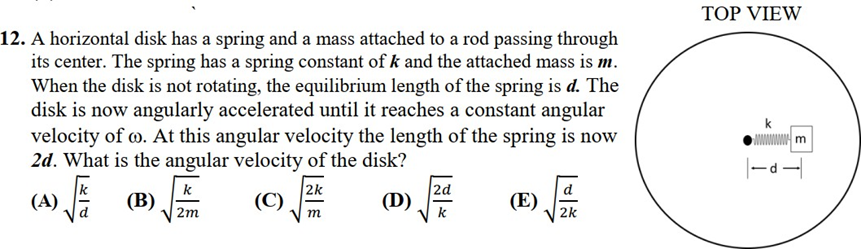
3. Suspiciously complex problems: look for the trap
When a problem provides an overwhelming number of conditions, do not panic — someone is trying to mislead you. In the first example below, the 28 m displacement is irrelevant; no displacement value affects the answer. In the second, a table of friction coefficients is provided, but the problem asks about an object at rest: circle "rest" and "60 N," find the matching answer choice (C), and move on.


Advanced Trick 1: Eliminate from the problem setup, then choose or guess

The first problem asks how much energy the man-boat system gains. The problem mentions both a man and a boat, so eliminate A and B immediately (single-object expressions). C implies the man and boat share one velocity — impossible, eliminate. E adds the combined energy with a shared denominator — dimensionally wrong, eliminate. Select D. Writing a quick momentum conservation equation makes it unambiguous, but elimination alone gets you there.
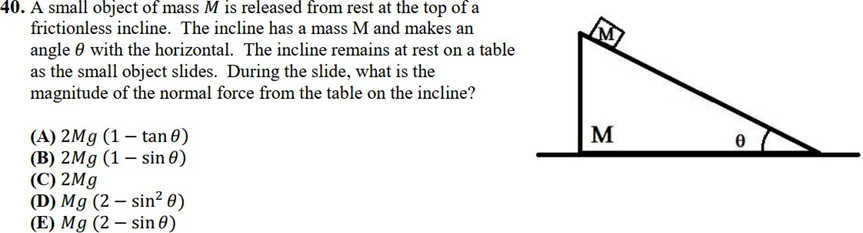
The second problem: at rest, the normal force would be 2Mg. The system is moving, so eliminate C. Two objects, the ramp itself is not moving, so any angle-dependent term in the numerator is suspect — eliminate A and B. Between D and E: the incline acceleration is g sinθ, and you need the vertical component, so another factor of sinθ is needed. Select D. If that reasoning is unclear, D is still the more complex of the two remaining options — and in Physics Bowl that is usually correct.
Advanced Trick 2: Simplify the scenario, pick the most reasonable answer
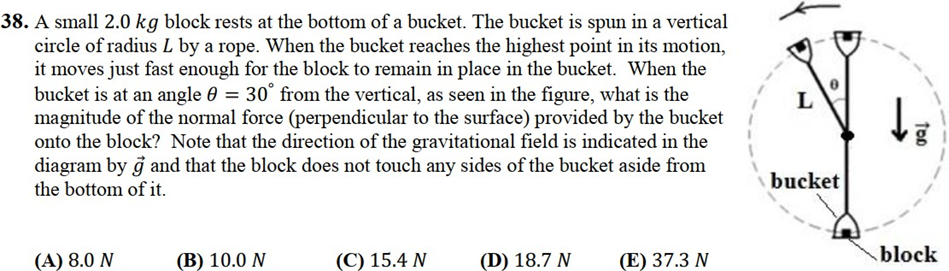
This problem distills Physics Bowl guessing to its essence. Step through it:
- L is not given, so L must cancel out of the answer — ignore energy considerations that would require knowing L.
- Simplify: treat the rotation as uniform circular motion.
- At the top, the normal force is 20 N and the support force is zero. At the 9 o'clock position only the support force provides centripetal force: 20 N. So passing through 30° of arc, the answer lies between 0 and 20 N — eliminate E.
- Only 30° of 90° has been traversed; the value should not be close to 20 N yet — eliminate C and D. Divide the range into thirds: roughly 7 N. Gravity is accelerating the system, so lean toward the lower end. Select A.
Starting from step three is also fine. This is not rigorous — but the time constraint is what it is.
Advanced Trick 3: Look hard at the numbers in the answer choices
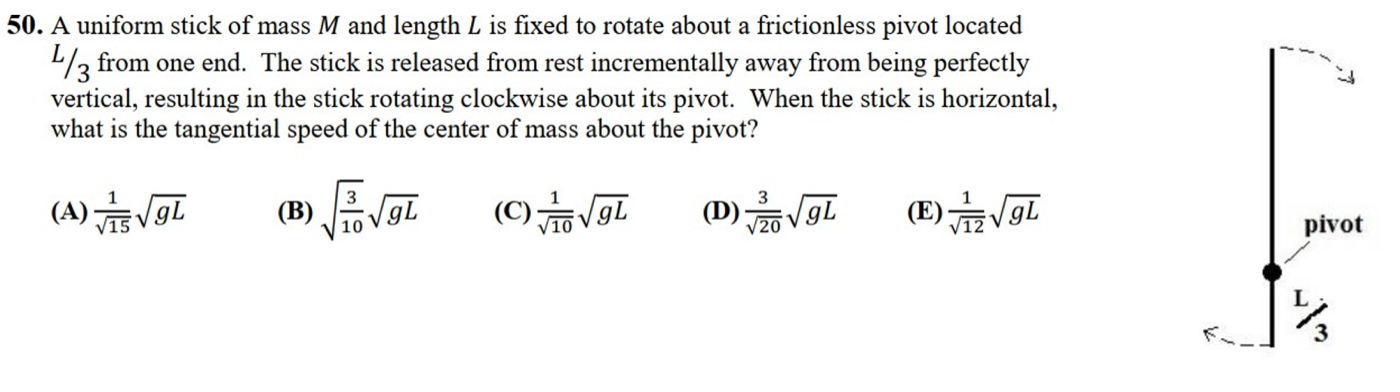
Numbers in answer choices carry information. This tail-end problem: the key insight is that the number 5 cannot plausibly emerge from any standard manipulation — moment of inertia, parallel-axis theorem, energy conservation — none of them naturally produce a factor of 5 unless you are literally adding 2 + 3. Every choice from A to D contains a multiple of 5. Since I cannot see how 5 appears, eliminate A through D and select E. The logic is elimination under uncertainty, not certainty — but it is valid elimination.