
2025 ISEF Regional: 100% Advancement Rate to Date
2025年ISEF区域赛截止目前晋级率100%
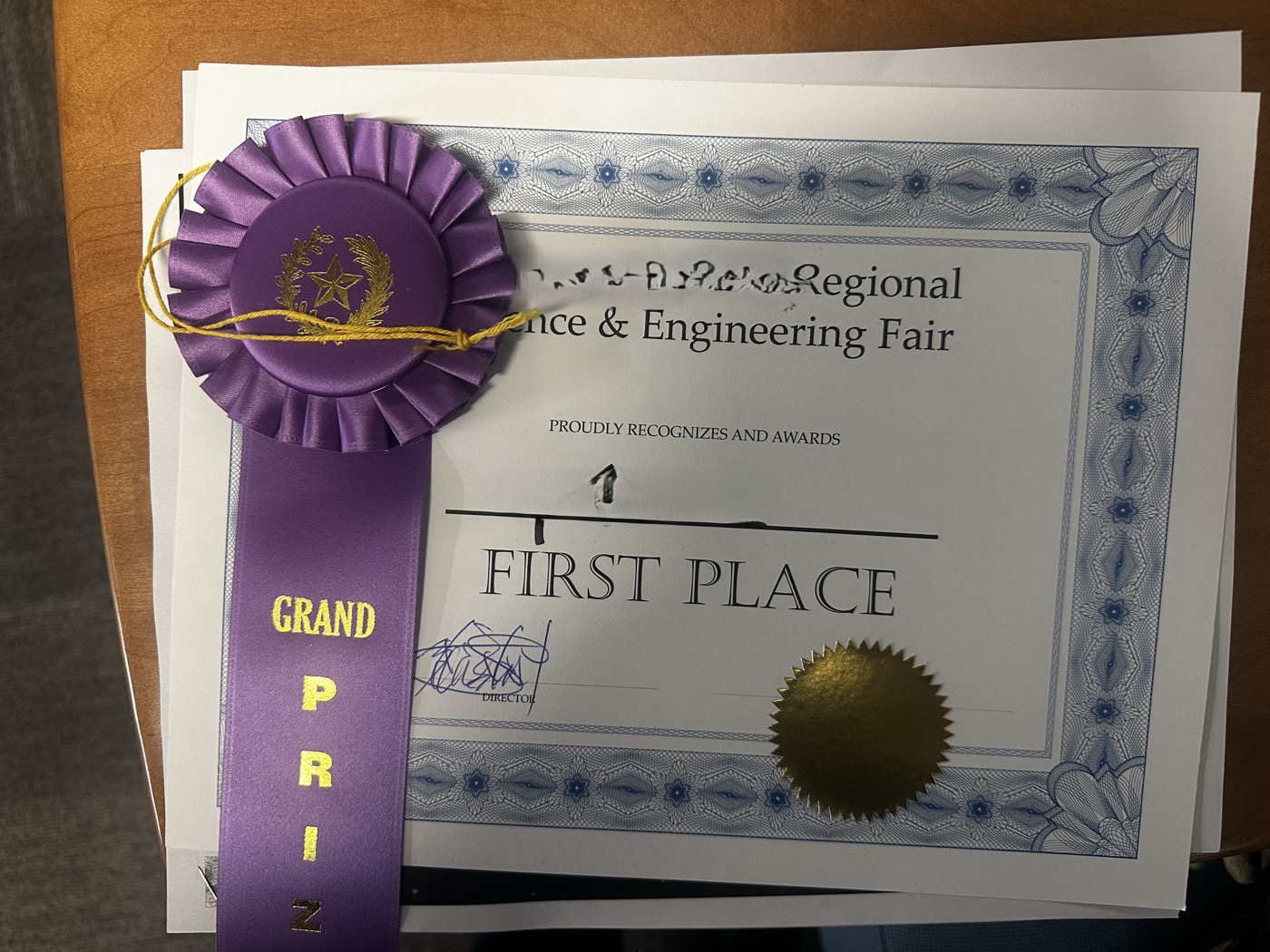
Another student finished their regional today, placing first and advancing to the state fair. That makes the running record for this cycle:
How the coaching model works — and why it is different
1. No topic provision — ever
This is the core distinction. Finding a genuinely excellent research mentor is extremely difficult; controlling the quality of what they produce is even harder. It is essentially a lottery.
The market for science-fair research mentors splits into two types. The first treats tutoring as a recurring income stream. These mentors can guarantee a floor of adequacy, but the output rarely has real competitive edge — producing good science requires a deep personal investment that is structurally incompatible with doing it for hourly fees across multiple students. The second type is graduate students or postdocs monetising their existing research. Their work may have genuine edge, but they have no teaching experience and essentially zero understanding of how science fairs work. In every multi-party arrangement I have seen involving this type — and I have sat at that coordination table — something goes wrong.
So I do not provide topics. Every student I coach brings their own project, or their family has identified the academic resource and I help scope the question. This triangle — student and family, domain mentor, competition coach — is stable in a way that two-in-one arrangements are not. The roles stay separate. The domain mentor owns the science; I own the packaging and the competition strategy. That separation means I can give an honest assessment: if the project has no competitive edge, I say so directly. If it is strong, we build on that strength.
2. Topic scoping support
The first step in any engagement is working with the student, the family, and their academic contact to settle on a question. For fields I know well I can assess directly; for others I will connect with a subject-matter colleague. If a family says they have no academic network, the answer is almost always that they do — a relative in graduate school, a family friend who works in a relevant field, a local university professor reachable by email. Graduate-level difficulty is the standard for regional and state fairs; the project does not need to rewrite the textbook.
3. Full registration and materials support
ISEF registration is genuinely complicated — IRB-equivalent documentation, school sign-off, forms that vary by region, hazardous-materials checks. I have navigated this process across more than a dozen different regional affiliates. Paperwork does not fail on my watch.
On the materials side: finals requires a quad chart, a poster, and a slide deck; regionals and state have their own requirements. The core work is narrative construction: how to tell the science story so that a judge understands it, values it, and remembers it. That is a craft that takes deliberate attention at every layer of the poster and every word of the abstract.
4. Interview coaching
The competition is an interview. Two things determine the outcome: whether you can explain your project to a non-specialist in under five minutes without losing the substance; and whether you can handle follow-up questions in a way that conveys genuine understanding rather than memorised lines. Both of these require practice — a lot of it, with real-time correction. This is the second core component of the coaching programme.
If you are entering ISEF this season and are uncertain about any part of the process, reach out by email.