AI Detection Rates in Fall 2025 College Essays
Fall 2025 申请季美本文书 AI 率的数据参考
A previous post about the S.-T. Yau Award was removed by the platform, so I needed something for the traffic-reward task and found myself at a loss for a clean new topic. Instead I took three main Common App essays I had been working on this cycle, ran them through GPTZero at different stages and editing intensities, and recorded the scores. People ask me constantly — "did this agency produce my essay with AI?" — so here is some actual data on what these scores mean.
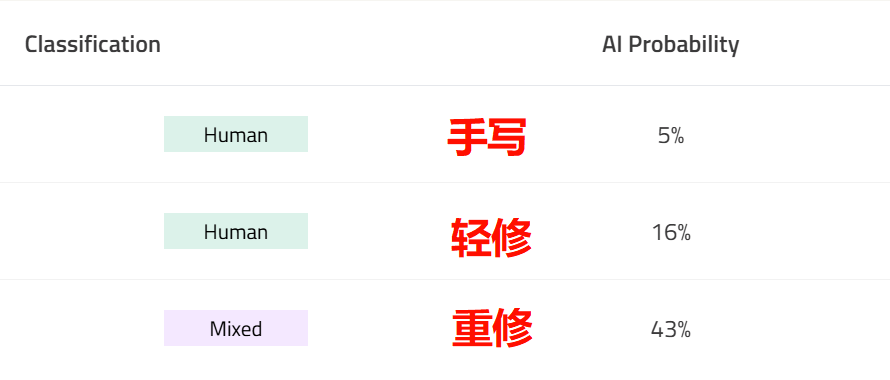
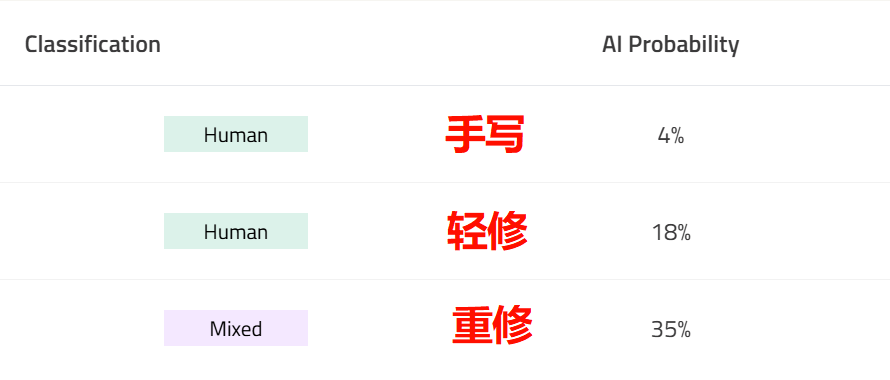
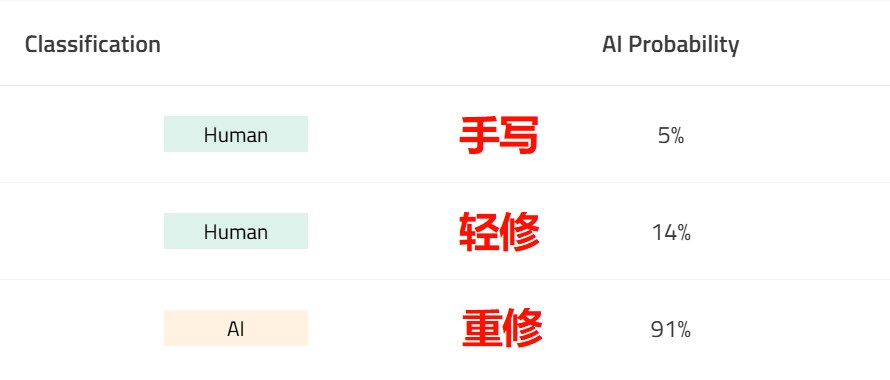
The working method for all three essays was the same: handwritten draft, then two rounds of AI editing. Round one was minimal — light wording fixes and grammar correction. Round two was maximal — asking the AI to improve to the best of its ability, with large changes permitted.
Essay 1
Essay 2
Essay 3
What the numbers actually mean
These are very simple observations on a small sample. Apply them as rough reference, not as rules. Individual writing levels vary, and a gifted counsellor who happens to write in a particularly clean, structured style might naturally produce scores in ranges you would not expect from a human. Here is what I noticed:
- 0–10%: entirely human-written. The score in this range reflects writing quality rather than AI involvement. A stronger writer naturally hits lower scores.
- 10–30%: light AI touch. Minor edits — fixing grammar, smoothing vocabulary, cleaning up sentence rhythm — typically land here. The prompt wording matters a lot; results vary. But in this range the essay still reads as human, and based on last year's results, submissions in this band had no issues.
- 40% range: AI-maximised revision. When you instruct the AI to push the essay to its best possible state with large changes allowed, results scatter between around 40% and 91%. The 40% versions tend to be the most accurate expresssion of the student's ideas — nothing that should be said gets omitted, and the sentence structure is precise. They also run long. These were submitted last year with strong admissions results. Whether the same holds in 2025 is less certain: this kind of precise, comprehensive articulation might now read as formulaic after readers have seen so much of it.
- 70%+: visibly AI. At this level I believe most experienced readers can tell. For any application programme that explicitly prohibits AI assistance in writing, a GPTZero score above 70% should be treated as a clear risk signal. Push back on any draft in this range.
- The laundering problem. AI can reduce its own AI score, but the resulting text loses almost all aesthetic quality. Watch out for a pattern where what you see being written feels polished and strong, but the AI-detection report you are shown was run on a de-AI'd version — which then gets quietly swapped back to the better-sounding AI draft for submission.
The 91% outlier is unexplained. I do not know how the same underlying essay produced that score under one prompt and 40% under another. It would not be submitted regardless.