SPC · Section Part I · MCQ

Waves and Oscillations

12 questions — reveal each answer and worked solution.

2007-7I · MCQd2Waves and Oscillations · optical path length / wavelength in medium

A thin rectangular block of glass, of thickness $t$, has a beam of light passing through it along a normal to a face, as shown in fig. 5. The light wave travels at a slower speed in glass than in air. The ratio of the extra number of waves introduced within the length $t$ when the glass is in place, to the number of waves within the same length $t$ in air, is given by

$$\lambda=\text { wavelength in air }$$

The refractive index, $n=\frac{\text { speed of light in air }}{\text { speed of light in glass }}$
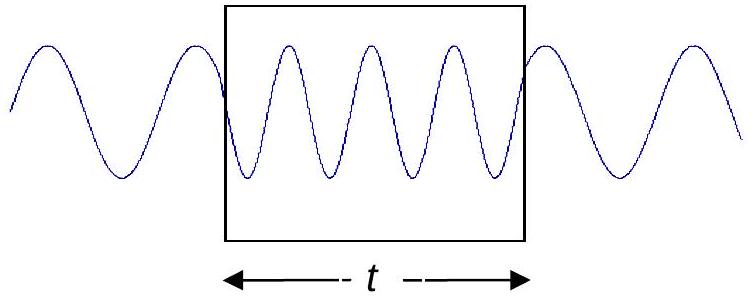
figure

A. $(n-1)$
B. $\frac{1}{(n+1)}$
C. $\frac{n}{(n+1)}$
D. $\frac{(n-1)}{n}$

Reveal answer
AnswerA
Show worked solution

We need to find the ratio of extra waves introduced in the glass to the number of waves in the same length of air.

Given:
- Wavelength in air: $\lambda$
- Refractive index: $n = \frac{c_{air}}{c_{glass}}$
- Glass thickness: $t$
Step 1: Number of waves in air

In air, over length $t$, the number of wavelengths is: $$N_{air} = \frac{t}{\lambda}$$

Step 2: Wavelength in glass

When light enters glass, its speed decreases: $c_{glass} = \frac{c_{air}}{n}$

Since frequency $f$ remains constant, the wavelength in glass is: $$\lambda_{glass} = \frac{c_{glass}}{f} = \frac{c_{air}}{nf} = \frac{\lambda}{n}$$

Step 3: Number of waves in glass

In glass, over the same length $t$, the number of wavelengths is: $$N_{glass} = \frac{t}{\lambda_{glass}} = \frac{t}{\lambda/n} = \frac{nt}{\lambda} = n \cdot N_{air}$$

Step 4: Extra waves introduced

The extra number of waves in glass compared to air is: $$\Delta N = N_{glass} - N_{air} = nN_{air} - N_{air} = (n-1)N_{air}$$

Step 5: Required ratio

The ratio of extra waves to the number of waves in air is: $$\text{Ratio} = \frac{\Delta N}{N_{air}} = \frac{(n-1)N_{air}}{N_{air}} = n-1$$

Therefore, the answer is A ($(n-1)$).
2007-8I · MCQd2Waves and Oscillations · single-slit diffraction / wavelength in medium

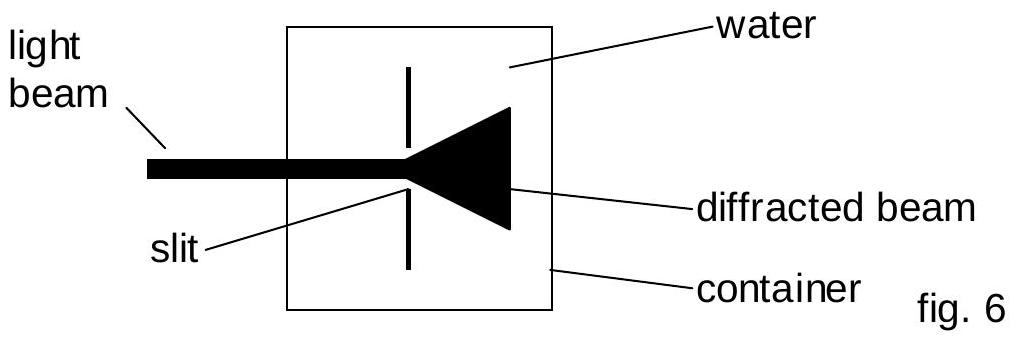
A narrow beam of light is incident normally upon a thin slit, and the light that passes through is spread out by diffraction. The thin slit is then immersed in a container of water. The beam of light is shone through the water and is again at normal incidence to the slit. The spread of the diffracted beam of light in water will be

figure

A. The same as in air
B. Diffraction will not occur in water
C. Less spread out than in air
D. More spread out than in air

Reveal answer
AnswerC
Show worked solution

This problem involves single-slit diffraction. The angular spread of the diffraction pattern is related to the wavelength and slit width.

Diffraction formula:

For single-slit diffraction, the first minimum occurs at angle $\theta$ where: $$\sin \theta = \frac{\lambda}{a}$$

where $\lambda$ is the wavelength and $a$ is the slit width.

The angular spread of the diffraction pattern is proportional to $\frac{\lambda}{a}$ - specifically, the spread increases with wavelength and decreases with slit width.

Effect of water:

When light enters water from air, its speed decreases due to the refractive index of water ($n_{water} \approx 1.33$). The frequency remains constant, but the wavelength changes:

$$\lambda_{water} = \frac{\lambda_{air}}{n_{water}}$$

Since $n_{water} > 1$, we have $\lambda_{water} < \lambda_{air}$.

Angular spread in water:

With the smaller wavelength in water: $$\sin \theta_{water} = \frac{\lambda_{water}}{a} = \frac{\lambda_{air}}{n_{water} \cdot a} = \frac{\sin \theta_{air}}{n_{water}}$$

Since $\sin \theta_{water} < \sin \theta_{air}$, the diffraction angle is smaller in water.

Therefore, the diffracted beam is less spread out in water than in air, which corresponds to answer C.

2008-1I · MCQd4Waves and Oscillations · diffraction intensity scaling

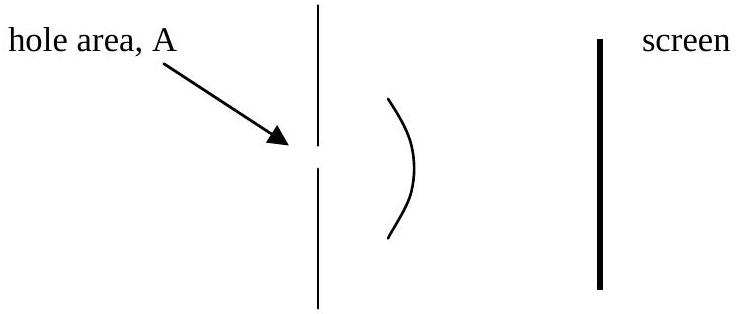
A beam of light of uniform intensity and of a single wavelength strikes a screen in which there is a small circular hole of area A . Some of the light passes through, and then spreads by diffraction, as shown below.

figure

At the centre of the diffracted wave which reaches the centre of the screen, the intensity of the light is $\mathrm{I}_{0}$ (intensity is the power per unit area). When the hole is made narrower, then the angular width of the beam increases, in such a way that for the diffracted beam, half the diameter of the hole will result in twice the width of the beam. If the diameter of the hole is halved, then what will be the new intensity at the centre of the diffracted beam?

A. $\mathrm{I}_{0} / 2$
B. $\mathrm{I}_{0} / 4$
C. $\mathrm{I}_{0} / 8$
D. $\mathrm{I}_{\mathrm{o}} / 16$

Reveal answer
AnswerD
Show worked solution

This problem involves diffraction through a circular aperture and how intensity changes with hole size.

Given: - Initial hole area: A
- Initial intensity at center: I0
- When diameter halves, angular width doubles (given relationship)
Key principle: For diffraction through a circular aperture (Airy disk), the angular width of the central maximum is inversely proportional to the diameter: $$\theta \propto \frac{1}{d}$$

When diameter is halved ($d \rightarrow d/2$): $$\theta \rightarrow 2\theta$$ This confirms the given relationship.

Effect on power through the hole:

The power passing through the hole is proportional to its area. Since area scales with diameter squared: $$A \propto d^2$$

When diameter halves: $d \rightarrow d/2$ $$A' \propto \left(\frac{d}{2}\right)^2 = \frac{d^2}{4} = \frac{A}{4}$$

Effect on intensity at center:

Intensity = Power/Area. The power is reduced by factor of 4, but the beam is now spread over a larger area due to diffraction. The central spot area scales as $\theta^2$, so: $$\text{Central spot area} \propto \theta^2$$

When $\theta \rightarrow 2\theta$: $$\text{Central spot area} \rightarrow 4 \times \text{original area}$$

Combined effect: $$I' = \frac{\text{Power}/4}{\text{Area} \times 4} = \frac{I_0}{16}$$

Therefore, the answer is D ($I_0/16$).

2008-4I · MCQd2Waves and Oscillations · acoustic reverberation time scaling

When a loud sharp sound is played in a room, the sound reverberates around the room until it gradually dies away. The reverberation time $T$ for a room of volume $V$ having surface area $A$ is given by the expression

$$T=\frac{k V}{\alpha A}$$

Where $k$ is a constant and $\alpha$ is a measure of the mean sound absorption by the surfaces.
If two rooms of identical shape and with walls of the same material, are tested for reverberation time, then for a room which is ten time longer, by what factor will the reverberation time be greater than for the smaller room?
A. 1000
B. 100
C. 10
D. It depends upon the other dimensions of the rooms

Reveal answer
AnswerC
Show worked solution

This problem involves scaling relationships for reverberation time in acoustically similar rooms.

Given: $$T = \frac{kV}{\alpha A}$$

where:
- $T$ = reverberation time
- $V$ = room volume
- $A$ = surface area
- $k$ = constant
- $\alpha$ = mean absorption coefficient
Scaling for identical shapes:

Rooms of identical shape have the same proportions, meaning all linear dimensions scale by the same factor.

For a characteristic length $L$: $$V \propto L^3 \quad \text{and} \quad A \propto L^2$$

Scaling by factor of 10:

When the room is "10 times longer" (all linear dimensions scale by 10): $$L' = 10L$$ $$V' = (10L)^3 = 1000L^3 = 1000V$$ $$A' = (10L)^2 = 100L^2 = 100A$$

New reverberation time:

$$T' = \frac{kV'}{\alpha A'} = \frac{k(1000V)}{\alpha(100A)} = \frac{1000}{100} \cdot \frac{kV}{\alpha A} = 10T$$

The reverberation time increases by a factor of 10, which corresponds to answer C.

2008-5I · MCQd3Waves and Oscillations · total internal reflection critical angle geometry

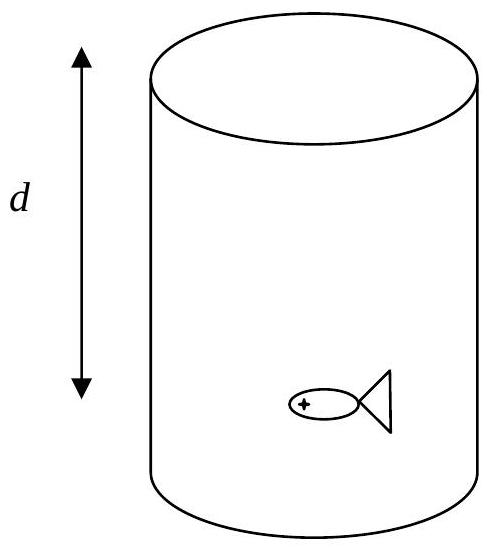
A fish floats in water with its eye at the centre of an opaque walled full tank of water of circular cross section. When the fish look upwards, it can see a fish-eye view of the surrounding scene i.e. it is able to view the hemisphere of the scene above the water surface, and centred at the top of the tank. The diameter of the tank is 30 cm , and the critical angle for water is $48^{\circ}$. At what depth below the surface of the water, $d$, must the fish be floating?

figure

A. 16.7 cm
B. 13.5 cm
C. 11.2 cm
D. 10.0 cm

Reveal answer
AnswerB
Show worked solution

This problem involves total internal reflection and the critical angle for viewing through water.

Given: - Tank diameter: 30 cm, so radius $r = 15$ cm
- Critical angle for water: $\theta_c = 48^\circ$
- Fish at center of circular tank, at depth $d$
- Fish can see entire hemisphere ($180^{\circ}$ view) above water
Physics principle:

For the fish to see the full hemisphere above water, light from the entire horizon must reach the fish's eye. The limiting case is light from the edge of the tank's rim. If light from beyond the rim cannot reach the fish (due to total internal reflection at the water-air interface), the fish's view is limited.

Light can only reach the fish from directions within the critical angle of the vertical. For a $180^{\circ}$ (hemispherical) view, the edge of the tank must be exactly at the critical angle.

Geometric analysis:

From the fish's position, the angle to the tank rim is: $$\tan\theta = \frac{\text{horizontal distance}}{\text{vertical depth}} = \frac{r}{d} = \frac{15}{d}$$

For full hemispherical view: $\theta = \theta_c = 48^\circ$

$$\tan(48^\circ) = \frac{15}{d}$$

$$d = \frac{15}{\tan(48^\circ)}$$

Using $\tan(48^\circ) \approx 1.11$: $$d \approx \frac{15}{1.11} \approx 13.5 \text{ cm}$$

Therefore, the fish must be at depth 13.5 cm, which corresponds to answer B.

2009-9I · MCQd3Waves and Oscillations · circular wave amplitude versus radius

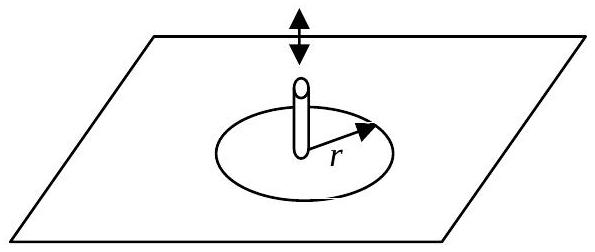
A wave on the surface of a liquid has amplitude $A$ when it is emitted from the source of the wave, which is a dipper moving up and down in the liquid. The wave spreads out over the plane surface of the liquid, forming a circle of radius $r$ which increases at the speed of the wave.
The energy of the wave is spread out over the circumference of the circle, so that as the circumference increases, the energy in a unit length of the circumference decreases as $1 / r$. If the energy of the wave is proportional to the square of its amplitude $A$, then what is the new amplitude of the wave when $r$ increases by four times from its previous value?

figure

A. $A / 2$
B. $A / 4$
C. $A / 8$
D. $A / 16$

Reveal answer
AnswerA
Show worked solution

This problem involves wave energy and amplitude as a circular wave spreads.

Given:
- Wave spreads in circle of radius r
- Energy per unit length: $\frac{dE}{d\ell} \propto \frac{1}{r}$
- Energy of wave: $E \propto A^2$ (proportional to amplitude squared)
- Find new amplitude when r increases by factor of 4
Energy analysis:

For a circular wave, the total energy E is distributed around the circumference $C = 2\pi r$.

The energy per unit length is: $$\frac{E}{C} = \frac{E}{2\pi r} \propto \frac{1}{r}$$

Amplitude relationship:

The problem states that the energy of the wave is proportional to the square of its amplitude: $$E \propto A^2$$

However, we need to consider what "energy of the wave" means. For the energy per unit length: $$\frac{E}{C} \propto A^2$$

But the energy per unit length decreases as 1/r: $$\frac{E}{C} \propto \frac{1}{r}$$

Therefore: $A^2 \propto \frac{1}{r}$

$$A \propto \frac{1}{\sqrt{r}}$$

When radius increases by factor of 4:

$$r' = 4r$$

$$A' = A \cdot \frac{1}{\sqrt{4}} = A \cdot \frac{1}{2} = \frac{A}{2}$$

The new amplitude is A/2.

Answer: A (A/2)

2011-4I · MCQd1Waves and Oscillations · dispersion of light by a prism

When light passes through a prism and is split into the colours of the spectrum, this is an example of: A. Dispersion B. Diffraction C. Reflection D. Refraction

Reveal answer
AnswerA
Show worked solution

This problem tests knowledge of optical phenomena.

Definitions of each option: A. Dispersion: The separation of white light into its component colors (spectrum) due to wavelength-dependent refraction. This is what happens in a prism. B. Diffraction: The bending of waves around obstacles or through apertures, causing interference patterns. C. Reflection: The bouncing of light off a surface at an angle equal to the incident angle. D. Refraction: The bending of light as it passes from one medium to another due to speed change. Analysis:

When white light enters a prism:
- Different wavelengths (colors) travel at different speeds in glass
- This causes different amounts of bending (refraction) for each color
- The light spreads out into a rainbow spectrum
This separation of colors due to wavelength-dependent refraction is called dispersion.

While refraction is involved in the process, the specific phenomenon of splitting into colors is dispersion.

Answer: A (Dispersion)

2012-4I · MCQd2Waves and Oscillations · multiple reflections in angled plane mirrors

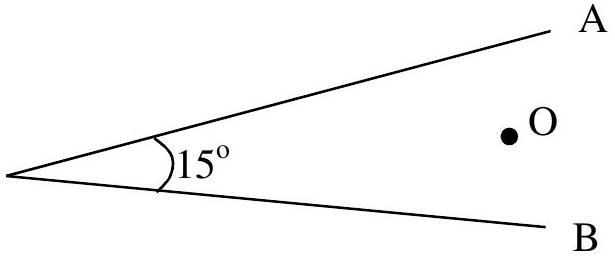
Two plane mirrors are at an angle of $15^{\circ}$ as shown in figure 1 below. A small object O is placed between them at an equal distance from mirror A and from mirror B. How many images can be seen (including the original)? (You can fit your eyeball between the mirrors if you want to)

figure

A. None B. 24 C. 36 D. 48

Reveal answer
AnswerB
Show worked solution

This problem involves multiple reflections in angled plane mirrors.

Given:
- Two plane mirrors at angle $\theta = 15^{\circ}$
- Object O placed at equal distance from both mirrors
- Find total number of images visible
Mirror image formula:

For two mirrors at angle $\theta$, the number of images is: $$N = \frac{360^{\circ}}{\theta} - 1$$

Derivation:

Each reflection creates a new image. The images are arranged in a circle around the intersection point of the mirrors. The angular separation between consecutive images equals the mirror angle.

Calculation:

$$N = \frac{360^{\circ}}{15^{\circ}} - 1$$

$$N = 24 - 1 = 23$$

Including the original object:

Total visible = Number of images + Original object

$$\text{Total} = 23 + 1 = 24$$

Verification:

With mirrors at $15^{\circ}$:
- $360^{\circ} / 15^{\circ} = 24$ positions around the circle
- One position is the actual object
- 23 positions contain images
- Total: 24 visible (object + 23 images)
Note: If $360^{\circ}/\theta$ is not an integer, the formula is more complex, but $3$ rac6015$ = 24$ exactly, so this simple formula applies.

Answer: B (24)

2015-3I · MCQd2Waves and Oscillations · EM wave wavelength from frequency

The second is now defined as the duration of 9192631770 periods of the radiation corresponding to the transition between two energy levels of the of the cesium 133 atom. What is the wavelength of the radiation emitted?
A. $\quad 3.3 \mathrm{~cm}$
B. $\quad 3.3 \mathrm{~mm}$
C. 31 m
D. $\quad 33 \mathrm{~cm}$

Reveal answer
AnswerA
Show worked solution

This problem involves cesium atomic clock radiation wavelength.

Given:
- 9,192,631,770 periods = 1 second
- Cesium-133 transition
Frequency:

$$f = 9,192,631,770 \text{ Hz} \approx 9.19 \times 10^9 \text{ Hz}$$

Wavelength:

$$\lambda = \frac{c}{f} = \frac{3.0 \times 10^8}{9.19 \times 10^9}$$

$$\lambda = 0.033 \text{ m} = 3.3 \text{ cm}$$

Answer: A (3.3 cm)

This is in the microwave region, which is why atomic clocks use microwave cavities!

2020-4I · MCQd1Waves and Oscillations · superposition and standing waves

A long rope is held by two students, one at each end, and they begin shaking the rope to send waves along it. As they change the frequency, they sometimes see the waves cancelling out and sometimes adding together, to produce a wave that appears to remain almost stationary. The physics principle used to explain these observed effects is
A. refraction
B. interference
C. diffraction
D. superposition
E. polarization

Reveal answer
AnswerE
Show worked solution

This problem involves wave physics.

The question mentions:
- Waves cancelling (destructive interference)
- Waves adding together (constructive interference)
- Stationary waves (standing waves)
The fundamental principle behind all these phenomena is superposition - the principle that when two or more waves overlap, the resultant displacement is the sum of the individual displacements.

While the question mentions interference and standing waves, the broader principle that explains all these effects is superposition.

Answer: E (superposition)
2022-5I · MCQd1Waves and Oscillations · wave speed, frequency and wavelength

A source of high frequency sound from a sonar under the ocean surface sends a 60 kHz sound towards the surface. What is the wavelength of sound in the air above? The speed of sound in air is $330 \mathrm{~m} \mathrm{~s}^{-1}$
A. 0.18 m
B. 0.18 mm
C. 5.5 m
D. 5.5 mm
E. 19.8 m

Reveal answer
AnswerD
Show worked solution

This problem involves wave speed and wavelength calculation.

Given:
- Frequency: $f = 60$ kHz $= 60 \times 10^{3}$ Hz
- Speed of sound in air: $v = 330$ m/s
Wave equation: $$v = f \lambda$$

where $\lambda$ is the wavelength.

Solving for wavelength: $$\lambda = \frac{v}{f} = \frac{330}{60 \times 10^{3}}$$

$$\lambda = 5.5 \times 10^{-3} \text{ m}$$

$$\lambda = 5.5 \text{ mm}$$

Physical insight:

High frequency sound has short wavelengths. 60 kHz is ultrasonic (above human hearing range of $\sim$20 kHz).

Answer: D (5.5 mm)
2023-3I · MCQd2Waves and Oscillations · wave phase difference from path length

A steady sound of 165 Hz is produced by a loudspeaker at one end of a field and it is received 157 m away. By what fraction of a cycle (measured in degrees from 0 to $360^{\circ}$) is the received signal out of phase?
The speed of sound in air is $330 \mathrm{~m} \mathrm{~s}^{-1}$
A. $0^{\circ}$
B. $45^{\circ}$
C. $90^{\circ}$
D. $135^{\circ}$
E. $180^{\circ}$

Reveal answer
AnswerE
Show worked solution

This problem involves wave phase and interference.

Given:
- Frequency: $f = 165$ Hz
- Distance: $d = 157$ m
- Speed of sound: $v = 330$ m/s
Wavelength calculation: $$\lambda = \frac{v}{f} = \frac{330}{165} = 2 \text{ m}$$ Phase difference:

The phase difference depends on how many wavelengths fit into the distance: $$N = \frac{d}{\lambda} = \frac{157}{2} = 78.5$$

This means:
- 78 complete wavelengths ($360^{\circ}$ each)
- Plus 0.5 wavelength = $180^{\circ}$
Phase calculation: $$\phi = 0.5 \times 360^{\circ} = 180^{\circ}$$

Physical interpretation:

The received signal is completely out of phase ($180^{\circ}$) with the source. If this were a single frequency, destructive interference would occur.

Answer: E ($180^{\circ}$)