SPC · Section Part I · MCQ

Modern Physics

3 questions — reveal each answer and worked solution.

2013-8I · MCQd2Modern Physics · photon energy and emission rate

A red laser pen produces monochromatic light of a wavelength of 633 nm. How many photons per second are produced by a 1 mW laser if all of the energy goes into producing the red light photons? The energy of a photon is given by $E=h f$.

$$\begin{gathered} c=3.0 \times 10^{8} \mathrm{~m} \mathrm{~s}^{-1} \\ h=6.6 \times 10^{-34} \mathrm{Js} \\ 1 \mathrm{~nm}=10^{-9} \mathrm{~m} \end{gathered}$$

A. $3.2 \times 10^{18}$ B. $3.2 \times 10^{15}$ C. $7.8 \times 10^{27}$ D. $3.2 \times 10^{33}$

Reveal answer
AnswerB
Show worked solution

This problem involves photon energy and calculating photon emission rate.

Given:
- Laser wavelength: $\lambda = 633$ nm $= 633 \times 10^{-9}$ m
- Laser power: $P = 1$ mW $= 10^{-3}$ W
- Planck constant: $h = 6.6 \times 10^{-34}$ J$\cdots$
- Speed of light: $c = 3.0 \times 10^8$ m/s
Energy per photon:

$$E_{photon} = hf = \frac{hc}{\lambda}$$

$$E_{photon} = \frac{6.6 \times 10^{-34} \times 3.0 \times 10^8}{633 \times 10^{-9}}$$

$$E_{photon} = \frac{19.8 \times 10^{-26}}{633 \times 10^{-9}}$$

$$E_{photon} = 3.13 \times 10^{-19} \text{ J}$$

Photons per second:

$$N = \frac{\text{Power}}{\text{Energy per photon}} = \frac{P}{E_{photon}}$$

$$N = \frac{10^{-3}}{3.13 \times 10^{-19}}$$

$$N = 3.19 \times 10^{15} \text{ photons/s}$$

$$N \approx 3.2 \times 10^{15} \text{ photons/s}$$

Verification:

Each red photon carries about $3 \times 10^{-19}$ J. At 1 mW ($10^{-3}$ J/s), we need about $3 \times 10^{15}$ photons per second.

Answer: B ($3.2 \times 10^{15}$)
2017-3I · MCQd2Modern Physics · particle beam energy calculation

The LHC accelerator at CERN has two beams of protons circulating in opposite directions, with each proton in a beam having an energy of 7.0 TeV. The circumference of the circular accelerator is 27 km and the particles are travelling at (almost) the speed of light. The protons circulate as bunches, with 2808 bunches per beam. There are $1.15 \times 10^{11}$ protons per bunch.

$$1 \mathrm{eV}=1.6 \times 10^{-19} \mathrm{~J}$$

What is the energy of each beam in joules?
A. $\mathbf{1 8 0 ~ M J}$
B. 360 MJ
C. $5.2 \times 10^{-5} \mathrm{~J}$
D. 360 J

Reveal answer
AnswerB
Show worked solution

This problem involves calculating LHC beam energy.

Given:
- Energy per proton: $7.0$ TeV $= 7.0 \times 10^{12}$ eV
- Protons per bunch: $1.15 \times 10^{11}$
- Bunches per beam: $2808$
- $1 \text{ eV} = 1.6 \times 10^{-19}$ J
Total protons per beam: $$N = 1.15 \times 10^{11} \times 2808 \approx 3.23 \times 10^{14}$$ Energy per beam: $$E = N \times 7.0 \times 10^{12} \times 1.6 \times 10^{-19}$$

$$E = 3.23 \times 10^{14} \times 1.12 \times 10^{-6}$$

$$E \approx 360 \times 10^6 \text{ J} = 360 \text{ MJ}$$

Answer: B (360 MJ)
2024-6I · MCQd2Modern Physics · Lorentz factor graph shape

The Lorentz factor, $\gamma$ (Greek letter gamma), is derived from Dutch physicist Henrik Lorentz's work on electrodynamics. It appears in Einstein's Special Relativity equations in which length, time, mass, momentum and energy are described for objects moving relative to an observer. The equation for $\gamma$ is commonly written as

$$\gamma=\frac{1}{\sqrt{1-\frac{v^{2}}{c^{2}}}}$$

where $v$ is the velocity of the moving object and $c$ is the speed of light.

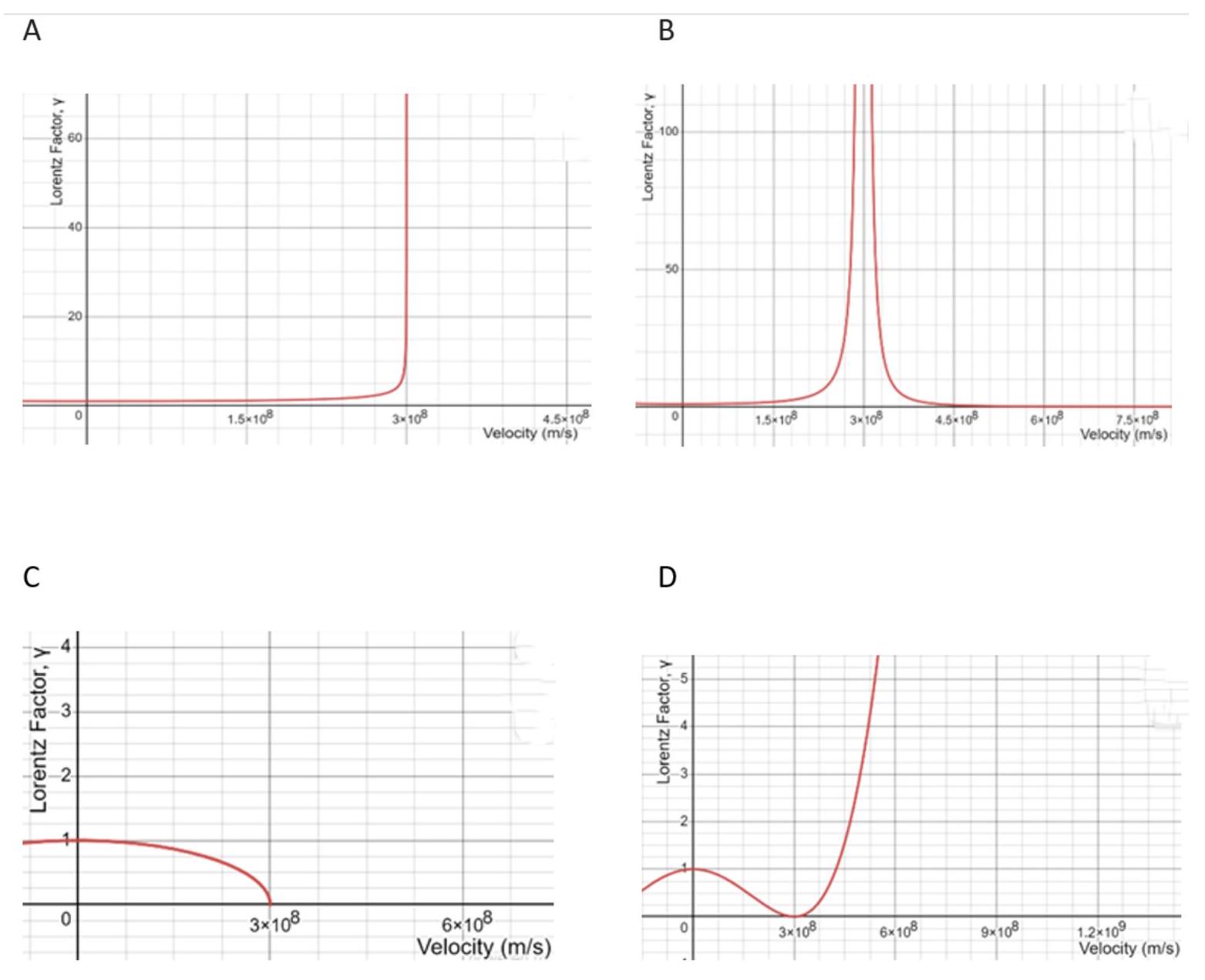
Which of the following graphs represents $\gamma$ as a function of $v$?

figure

A.
B.
C.
D.

Reveal answer
AnswerA
Show worked solution

This problem involves special relativity and the Lorentz factor.

The Lorentz factor: $$\gamma = \frac{1}{\sqrt{1 - \frac{v^{2}}{c^{2}}}}$$ Behavior analysis: At $v = 0$: $$\gamma = \frac{1}{\sqrt{1 - 0}} = 1$$ As $v \rightarrow c$: $$\frac{v}{c} \rightarrow 1$$ $$1 - \frac{v^{2}}{c^{2}} \rightarrow 0$$ $$\gamma \rightarrow \infty$$ For small $v \ll c$: $$\gamma \approx 1 + \frac{v^{2}}{2c^{2}}$$ Graph characteristics:
- Starts at $\gamma = 1$ when $v = 0$
- Increases slowly at low speeds
- Curves upward sharply as $v \rightarrow c$
- Approaches infinity (vertical asymptote) at $v = c$
Answer: A

Graph A shows this behavior: starts at 1, gradual increase, then shoots up to infinity as velocity approaches $c$.