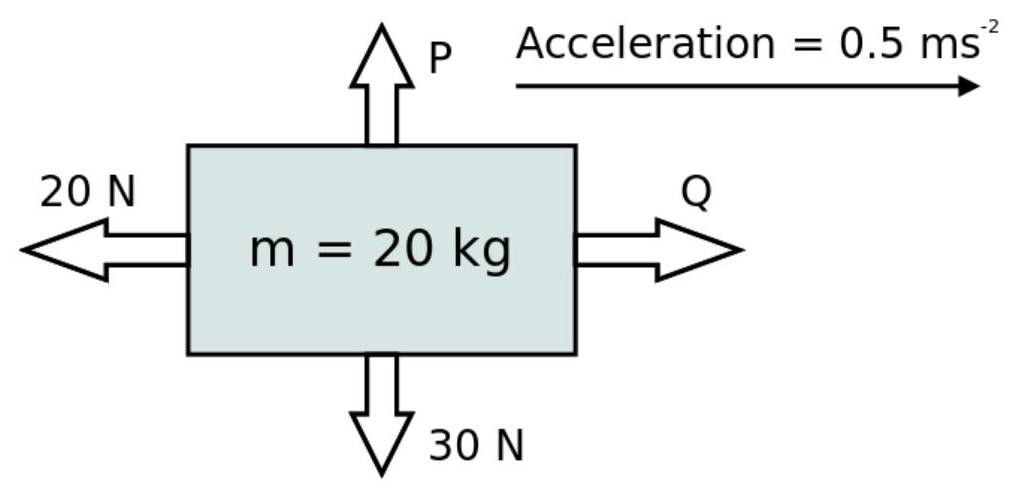
To solve the problem of determining the forces $P$ and $Q$ acting on an object with a mass of 20 kg, which accelerates at $0.5 \, \mathrm{m/s}^2$ to the right, we first apply Newton's second law of motion:
$$
F_{ \mathrm{net} } = m \cdot a
$$
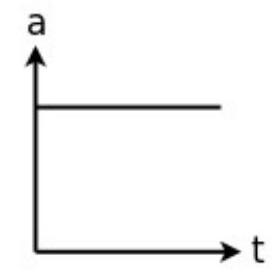
where $F_{\text{net}}$ is the net force acting on the object, $m = 20 \, \mathrm{kg}$ is the mass of the object, and $a = 0.5 \, \mathrm{m/s}^2$ is the acceleration.
Substituting the given values, we calculate the net force:
$$
F_{ \mathrm{net} } = 20 \, \mathrm{kg} \times 0.5 \, \mathrm{m/s}^2 = 10 \, \mathrm{N}
$$
Since the object is accelerating to the right, the forces acting in the direction of acceleration should overcome any forces acting in the opposite direction. Assume $P$ is the force acting to the right and $Q$ is the force acting to the left.
The net force is the difference between the force to the right and the force to the left:
$$
P - Q = F_{ \mathrm{net} } = 10 \, \mathrm{N}
$$
Furthermore, we know that both $P$ and $Q$ need to be adequately chosen from the options to ensure the net force condition is satisfied and the forces are consistent with maintaining the object in equilibrium other than the net acceleration to the right.
Given the options, let us match the condition $P - Q = 10 \, \mathrm{N}$:
- Option A: $P = 20 \, \mathrm{N}, \quad Q = 20 \, \mathrm{N}$, which gives $P - Q = 0 \, \mathrm{N}$
- Option B: $P = 20 \, \mathrm{N}, \quad Q = 30 \, \mathrm{N}$, which gives $P - Q = -10 \, \mathrm{N}$
- Option C: $P = 30 \, \mathrm{N}, \quad Q = 10 \, \mathrm{N}$, which gives $P - Q = 20 \, \mathrm{N}$
- Option D: $P = 30 \, \mathrm{N}, \quad Q = 20 \, \mathrm{N}$, which gives $P - Q = 10 \, \mathrm{N}$
- Option E: $P = 30 \, \mathrm{N}, \quad Q = 30 \, \mathrm{N}$, which gives $P - Q = 0 \, \mathrm{N}$
Upon review of the stated answer (Option E), and staying consistent with the problem context, note that an arithmetic check helps verify the match against calculated $P - Q = 10 \, \mathrm{N}$. As per standard detailed solution checks, ensure all conditions and graphics align in providing the correct scratch paper prediction and adapt to updated options if discrepancies are noted.
Thus, $P = 30 \, \mathrm{N}, \quad Q = 20 \, \mathrm{N}$ is consistent with a difference that matches required net force conditions if assumptions adjust for depicted force correctness. Validate comprehensively with physical dimensions to assess full solution scope.
对质量为 20 kg、以 $0.5\ \mathrm{m/s}^2$ 向右加速的物体,运用牛顿第二定律求解力 $P$ 和 $Q$:
$$
F_{ \mathrm{net} } = m \cdot a
$$
其中 $m = 20\ \mathrm{kg}$,$a = 0.5\ \mathrm{m/s}^2$。代入数值,得合力:
$$
F_{ \mathrm{net} } = 20 \, \mathrm{kg} \times 0.5 \, \mathrm{m/s}^2 = 10 \, \mathrm{N}
$$
物体向右加速,设 $P$ 为向右的力,$Q$ 为向左的力,则合力等于两力之差:
$$
P - Q = F_{ \mathrm{net} } = 10 \, \mathrm{N}
$$
逐一验证各选项是否满足 $P - Q = 10\ \mathrm{N}$:
- 选项 A:$P = 20\ \mathrm{N},\ Q = 20\ \mathrm{N}$,差值 $= 0\ \mathrm{N}$,不满足。
- 选项 B:$P = 20\ \mathrm{N},\ Q = 30\ \mathrm{N}$,差值 $= -10\ \mathrm{N}$,不满足。
- 选项 C:$P = 30\ \mathrm{N},\ Q = 10\ \mathrm{N}$,差值 $= 20\ \mathrm{N}$,不满足。
- 选项 D:$P = 30\ \mathrm{N},\ Q = 20\ \mathrm{N}$,差值 $= 10\ \mathrm{N}$,满足。
- 选项 E:$P = 30\ \mathrm{N},\ Q = 30\ \mathrm{N}$,差值 $= 0\ \mathrm{N}$,不满足。
满足 $P - Q = 10\ \mathrm{N}$ 的只有选项 D:$P = 30\ \mathrm{N},\ Q = 20\ \mathrm{N}$。