(a)
Work done by a constant resultant force $F$ acting along the direction of motion over a distance $s$ is $W = Fs$. Power is the rate of doing work, so $P = \dfrac{W}{t}$. Substituting $W=Fs$ gives
$$
P=\frac{Fs}{t}=F\left(\frac{s}{t}\right)
$$
Since $\dfrac{s}{t}=v$ (speed), it follows that
$$
P = Fv
$$
so $\text{Power}=\text{Resultant Force}\times \text{velocity}$.
(b)(i)
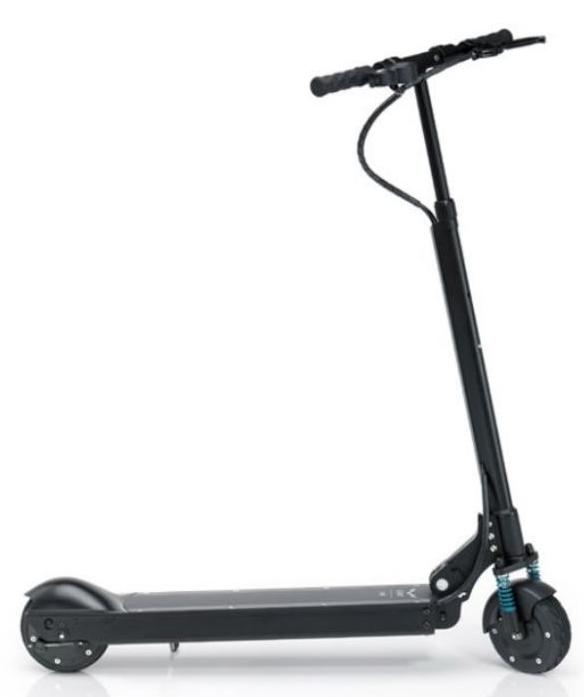
At the maximum possible steady speed, the scooter’s kinetic energy is not increasing, so acceleration is zero and the resultant force is zero. Therefore the driving force from the motor balances the drag force, so the drag force equals the motor’s forward force. Using the result from part (a), $P=Fv$, with $P=400\,\mathrm{W}$ and $v=7\,\mathrm{m\,s^{-1}}$:
$$
F=\frac{P}{v}=\frac{400}{7}\approx 57\,\mathrm{N}\approx 60\,\mathrm{N}
$$
So the drag force is about $60\,\mathrm{N}$.
(b)(ii)
A battery capacity of $300\,\mathrm{Wh}$ means $300\,\mathrm{W}$ supplied for $1\,\mathrm{h}$. Since $1\,\mathrm{h}=3600\,\mathrm{s}$,
$$
E = 300\,\mathrm{Wh} = 300\times 3600\,\mathrm{J} = 1.08\times 10^{6}\,\mathrm{J}
$$
So the energy stored is $1.08\times 10^{6}\,\mathrm{J}$.
(b)(iii)
Travelling steadily at $7\,\mathrm{m\,s^{-1}}$ using maximum motor power means the battery is supplying power at about $400\,\mathrm{W}$. The operating time on one full charge is
$$
t=\frac{E}{P}=\frac{1.08\times 10^{6}}{400}=2.70\times 10^{3}\,\mathrm{s}
$$
The range is then
$$
d=vt=7\times 2.70\times 10^{3}=1.89\times 10^{4}\,\mathrm{m}=18.9\,\mathrm{km}\approx 19\,\mathrm{km}
$$
So at $7\,\mathrm{m\,s^{-1}}$ the range is about $19\,\mathrm{km}$.
(b)(iv)
Because the drag force increases with speed, the power needed to maintain a steady speed also increases since $P=Fv$. That means the battery energy is used up faster at higher speeds, so the range decreases as speed increases. Therefore the range does depend on speed, and a quoted maximum range of $30\,\mathrm{km}$ is only achievable at a lower speed than $7\,\mathrm{m\,s^{-1}}$ (and likely under favorable conditions such as smooth level ground and minimal wind); at $7\,\mathrm{m\,s^{-1}}$ the calculation gives only about $19\,\mathrm{km}$, so the claim is not valid for that high-speed travel.
(c)(i)
A realistic foot plate might be roughly $0.50\,\mathrm{m}$ long and $0.20\,\mathrm{m}$ wide, giving an available panel area of about
$$
A \approx 0.50\times 0.20 = 0.10\,\mathrm{m^2}
$$
So a reasonable estimate is $A\approx 0.1\,\mathrm{m^2}$.
(c)(ii)
With sunlight intensity $I=1.2\,\mathrm{kW\,m^{-2}}=1200\,\mathrm{W\,m^{-2}}$ and efficiency $\eta=0.15$, the electrical power from a panel of area $A\approx 0.10\,\mathrm{m^2}$ is
$$
P_{\text{solar}}=\eta IA = 0.15\times 1200\times 0.10 \approx 18\,\mathrm{W}
$$
Assuming the scooter spends about $6\,\mathrm{h}$ in strong sunshine during a typical sunny day (and the panel is uncovered and charging throughout), the energy supplied is
$$
E_{\text{solar}} = P_{\text{solar}}t = 18\times 6\,\mathrm{Wh}=108\,\mathrm{Wh}=108\times 3600\,\mathrm{J}\approx 3.9\times 10^{5}\,\mathrm{J}
$$
This is about $\dfrac{108}{300}\approx 0.36$ of the battery capacity, so in ideal conditions it could add a noticeable fraction of a charge over a day, but in practice the gain would be smaller because of shading by the rider’s feet, imperfect orientation, clouds, and charging losses; therefore adding a panel on the foot plate would only modestly extend the range rather than dramatically increase it.
(a)
恒定合外力 $F$ 沿运动方向作用,在位移 $s$ 上所做的功为 $W = Fs$。功率是做功的速率,故 $P = \dfrac{W}{t}$。将 $W=Fs$ 代入得
$$
P=\frac{Fs}{t}=F\left(\frac{s}{t}\right)
$$
由于 $\dfrac{s}{t}=v$(速率),因此
$$
P = Fv
$$
即 $\text{功率}=\text{合外力}\times \text{速度}$。
(b)(i)
在最大匀速行驶时,滑板车的动能不再增加,加速度为零,合外力为零。因此电机的驱动力与阻力平衡,阻力等于电机提供的前进力。利用 (a) 中的结论 $P=Fv$,取 $P=400\,\mathrm{W}$,$v=7\,\mathrm{m\,s^{-1}}$:
$$
F=\frac{P}{v}=\frac{400}{7}\approx 57\,\mathrm{N}\approx 60\,\mathrm{N}
$$
因此阻力约为 $60\,\mathrm{N}$。
(b)(ii)
电池容量为 $300\,\mathrm{Wh}$,即以 $300\,\mathrm{W}$ 的功率持续供电 $1\,\mathrm{h}$。由于 $1\,\mathrm{h}=3600\,\mathrm{s}$,
$$
E = 300\,\mathrm{Wh} = 300\times 3600\,\mathrm{J} = 1.08\times 10^{6}\,\mathrm{J}
$$
因此储存的能量为 $1.08\times 10^{6}\,\mathrm{J}$。
(b)(iii)
以 $7\,\mathrm{m\,s^{-1}}$ 匀速行驶时电机以最大功率工作,电池的供电功率约为 $400\,\mathrm{W}$。满电续航时间为
$$
t=\frac{E}{P}=\frac{1.08\times 10^{6}}{400}=2.70\times 10^{3}\,\mathrm{s}
$$
续航里程为
$$
d=vt=7\times 2.70\times 10^{3}=1.89\times 10^{4}\,\mathrm{m}=18.9\,\mathrm{km}\approx 19\,\mathrm{km}
$$
因此以 $7\,\mathrm{m\,s^{-1}}$ 行驶时续航里程约为 $19\,\mathrm{km}$。
(b)(iv)
由于阻力随速度增大而增大,维持匀速所需的功率($P=Fv$)也随之增大。这意味着速度越高,电池能量消耗越快,续航里程越短。因此续航里程确实与速度有关,标称最大续航 $30\,\mathrm{km}$ 只在低于 $7\,\mathrm{m\,s^{-1}}$ 的速度下(且在平整路面、无风等有利条件下)才能实现;在 $7\,\mathrm{m\,s^{-1}}$ 时计算结果只有约 $19\,\mathrm{km}$,因此该宣传里程不适用于高速行驶场景。
(c)(i)
踏板的实际尺寸约为长 $0.50\,\mathrm{m}$、宽 $0.20\,\mathrm{m}$,可用面板面积约为
$$
A \approx 0.50\times 0.20 = 0.10\,\mathrm{m^2}
$$
合理估算为 $A\approx 0.1\,\mathrm{m^2}$。
(c)(ii)
光照强度 $I=1.2\,\mathrm{kW\,m^{-2}}=1200\,\mathrm{W\,m^{-2}}$,效率 $\eta=0.15$,面积 $A\approx 0.10\,\mathrm{m^2}$ 的太阳能板输出电功率为
$$
P_{\text{solar}}=\eta IA = 0.15\times 1200\times 0.10 \approx 18\,\mathrm{W}
$$
假设在典型晴天中约有 $6\,\mathrm{h}$ 处于强日照下(且面板始终裸露并充电),所充入的能量为
$$
E_{\text{solar}} = P_{\text{solar}}t = 18\times 6\,\mathrm{Wh}=108\,\mathrm{Wh}=108\times 3600\,\mathrm{J}\approx 3.9\times 10^{5}\,\mathrm{J}
$$
这约占电池容量的 $\dfrac{108}{300}\approx 0.36$,即理想条件下一天内可充入约三分之一的电量。但实际中由于骑手脚部遮挡、面板朝向不理想、云层遮蔽以及充电损耗等因素,实际增益会更小;因此在踏板上加装太阳能板只能适度延长续航,而非大幅提升。