(2010-13: Free fall and air resistance) A package is dropped from rest from a very tall tower and then, after some time, a parachute opens to slow the package down.
Initially the parachute is closed and the whole package is approximately a sphere of radius 50 cm and mass 40 kg .
As the package falls through the air, the drag force increases as the velocity increases and, eventually, the package achieves its terminal velocity.
The drag force (D) acting on the package is given by the equation:
Drag force $=$ constant $(\mathrm{k}) \mathrm{x}$ cross sectional area $(\mathrm{A}) \mathrm{x}$ velocity $(\mathrm{v})$ squared $\mathrm{D}=\mathrm{kAv}{ }^{2}$
where: $\mathrm{k}=0.7 \mathrm{Ns}^{2} / \mathrm{m}^{4}$
A is the cross sectional area of the sphere
(i.e. the area of a circle of the same radius)
v is the velocity
(a) Show that the terminal velocity of the package before the parachute opens is approximately $27 \mathrm{~m} / \mathrm{s}$.
(b) Without further calculation, state and explain how the terminal velocity would be affected if the 40 kg package had a higher density than the package considered in (a).
The package considered in part (a) is travelling at its terminal velocity when the parachute is opened.
Assume the stated drag formula also applies to the parachute when it is open.
(c) Estimate the area of the parachute needed to reduce the terminal velocity of the package to $10 \mathrm{~m} / \mathrm{s}$.
(d) Calculate the resultant force acting on the package and parachute immediately after the parachute opens (assume the parachute opens instantly so that the parachute is initially moving at $27 \mathrm{~m} / \mathrm{s}$ ).
(e)
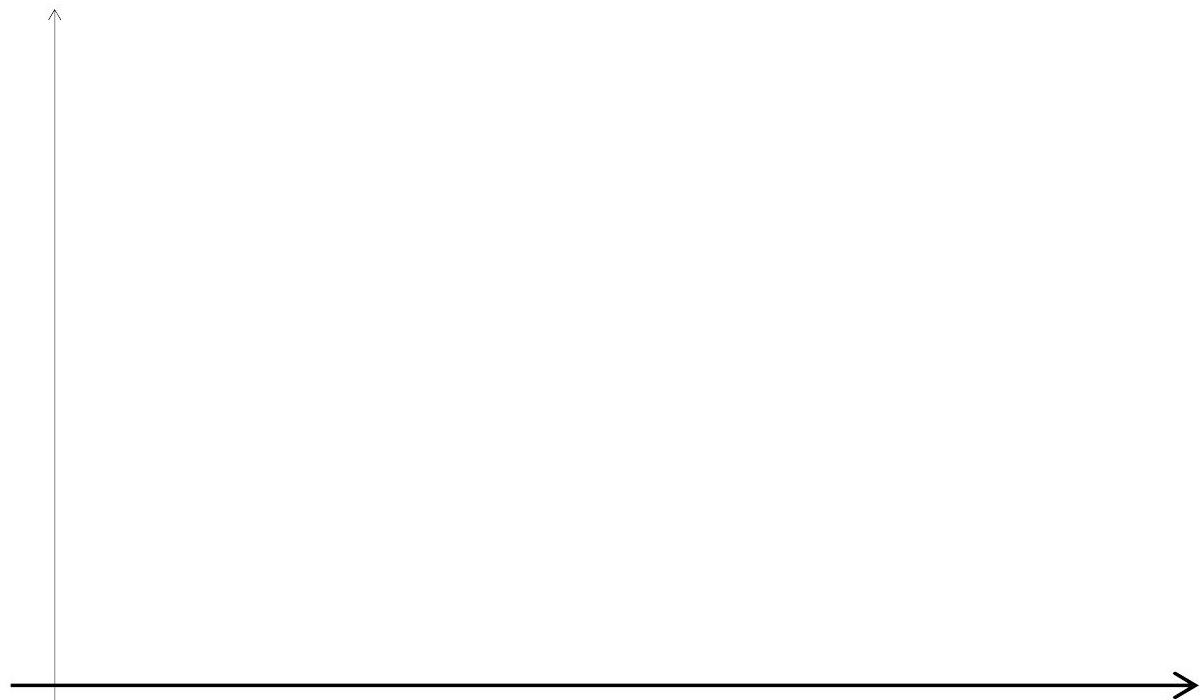
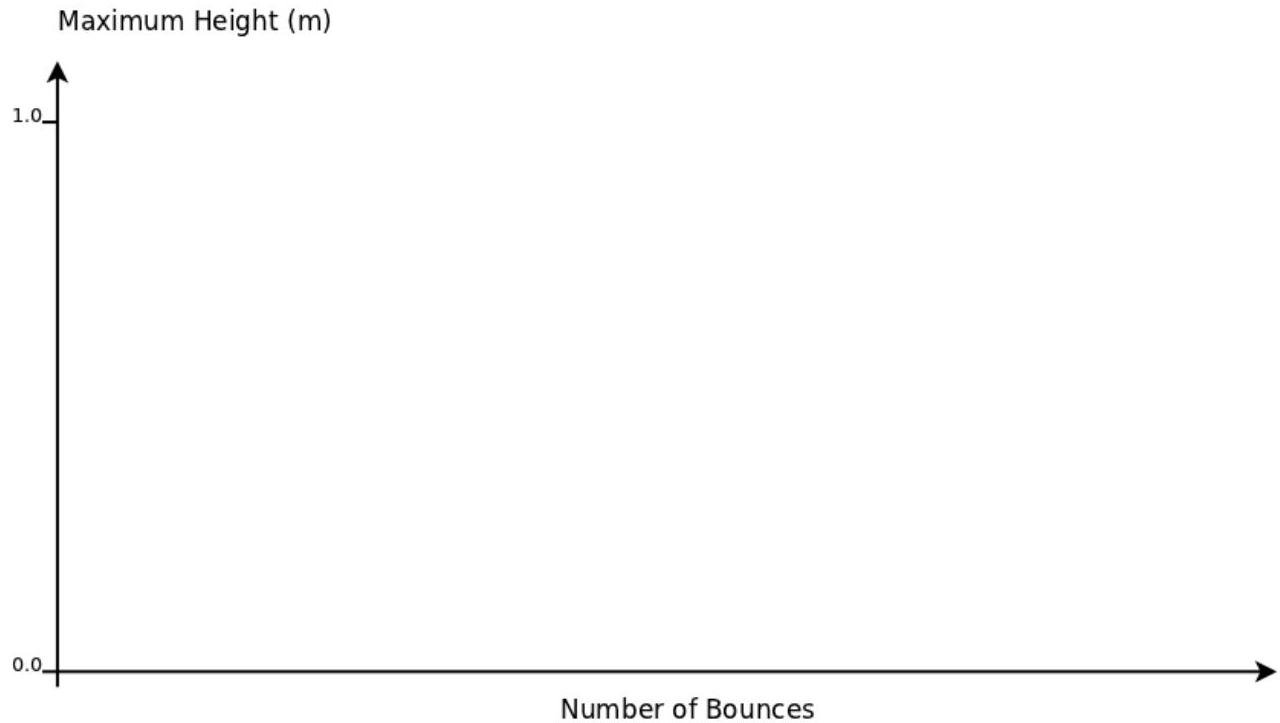
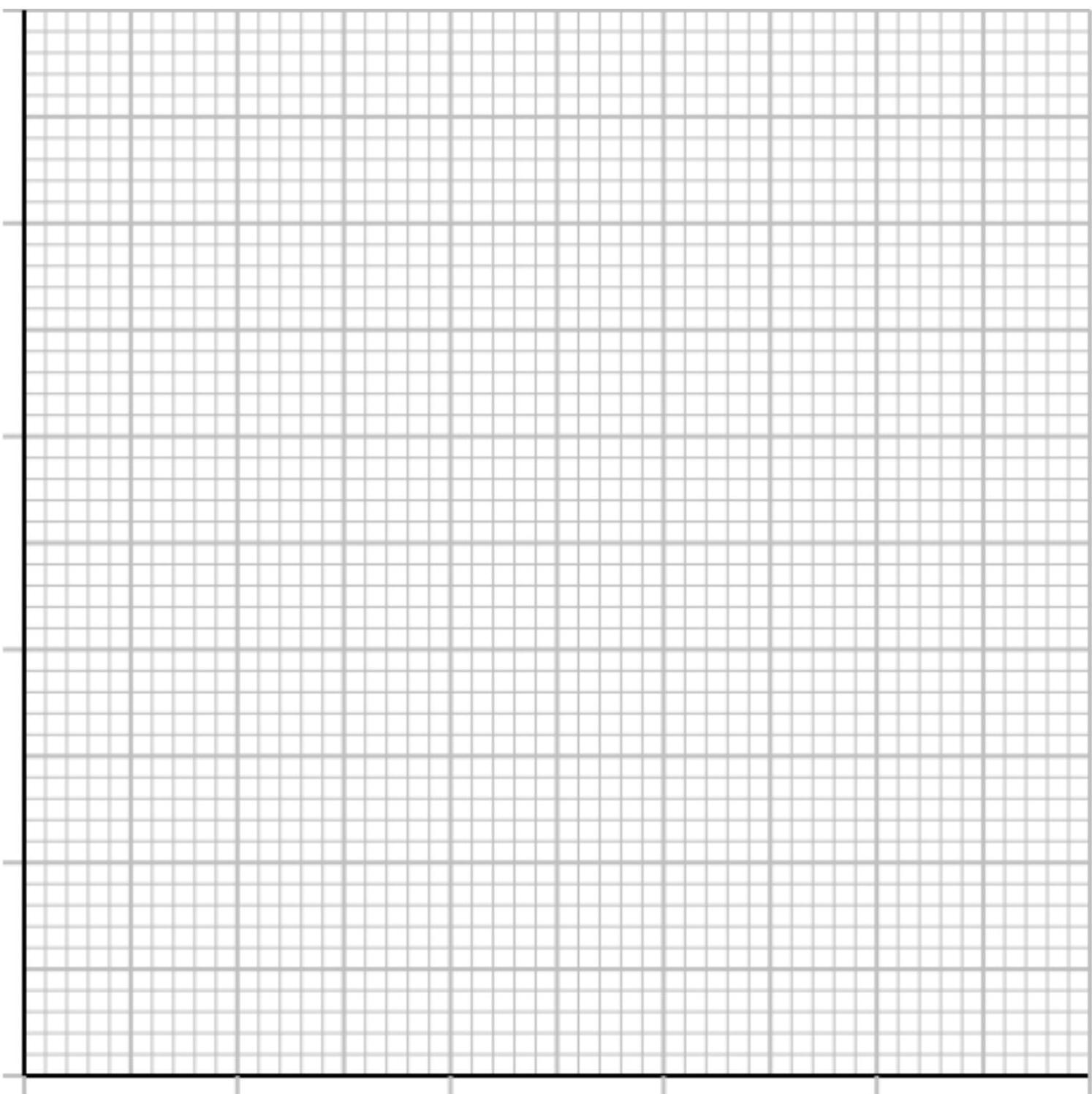
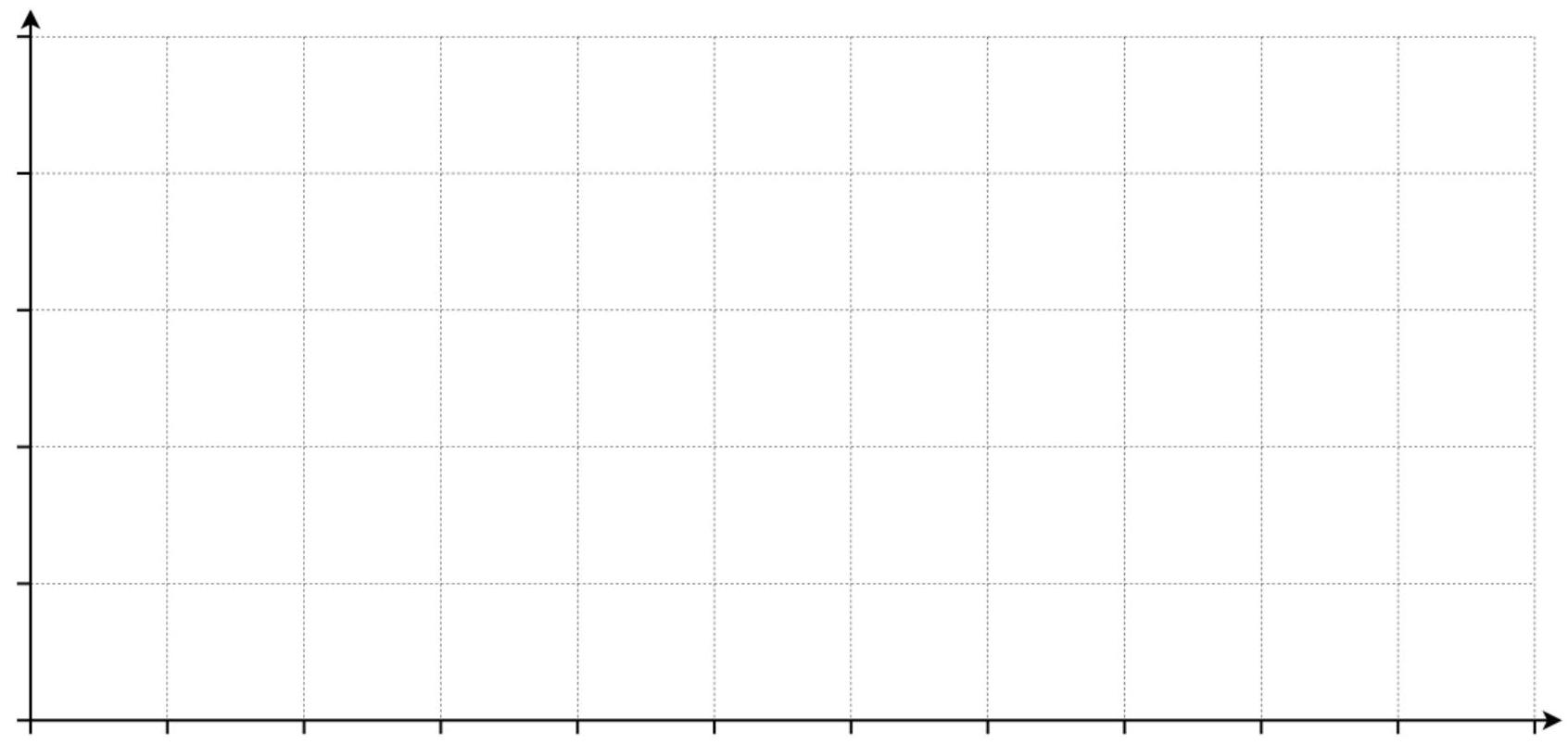
In the space below draw an acceleration-time graph for the package from the moment it is released from rest until after the parachute opens and it achieves a final terminal velocity of $10 \mathrm{~m} / \mathrm{s}$.
Include a scale on the acceleration axis to show all significant values.
It is not necessary to indicate a scale on the time axis.
Show worked solution
At terminal velocity the acceleration is zero, so the resultant force is zero and the weight is balanced by the drag force: $$ mg=D=kAv_t^2 $$ The package is a sphere of radius $r=0.50\,\mathrm{m}$, so its cross-sectional area is the area of a circle: $A=\pi r^2=\pi(0.50)^2=0.25\pi\approx 0.785\,\mathrm{m}^2$. Using $m=40\,\mathrm{kg}$, $g=9.8\,\mathrm{m\,s^{-2}}$, and $k=0.7\,\mathrm{Ns^2\,m^{-4}}$: $$ v_t=\sqrt{\frac{mg}{kA}}=\sqrt{\frac{40\times 9.8}{0.7\times 0.785}} =\sqrt{\frac{392}{0.5495}} =\sqrt{713.6}\approx 26.7\,\mathrm{m\,s^{-1}}\approx 27\,\mathrm{m\,s^{-1}} $$ So the terminal velocity before the parachute opens is approximately $27\,\mathrm{m\,s^{-1}}$.
(b)If the package has the same mass ($40\,\mathrm{kg}$) but higher density, it must have a smaller volume and therefore a smaller radius, giving a smaller cross-sectional area $A$. Since terminal speed satisfies $v_t=\sqrt{mg/(kA)}$, decreasing $A$ makes $mg/(kA)$ larger, so $v_t$ increases. The package would fall faster because it presents a smaller area to the airflow for the same weight.
(c)For the new terminal velocity $v_t=10\,\mathrm{m\,s^{-1}}$ with the parachute open, the terminal condition is again $mg=kAv_t^2$, now with $A$ being the effective cross-sectional area of the parachute (dominant compared with the package): $$ A=\frac{mg}{kv_t^2}=\frac{40\times 9.8}{0.7\times 10^2} =\frac{392}{70}=5.6\,\mathrm{m}^2 $$ So the parachute area needed is approximately $5.6\,\mathrm{m}^2$.
(d)Immediately after opening, the speed is still $v=27\,\mathrm{m\,s^{-1}}$ but the area is now $A=5.6\,\mathrm{m}^2$, so the drag is $$ D=kAv^2=0.7\times 5.6\times 27^2 =(3.92)\times 729\approx 2.86\times 10^3\,\mathrm{N} $$ Drag acts upward while weight $mg=392\,\mathrm{N}$ acts downward, so the resultant force is upward with magnitude $$ F_{\text{res}}=D-mg\approx 2.86\times 10^3-392\approx 2.47\times 10^3\,\mathrm{N} $$ The acceleration magnitude is $a=F_{\text{res}}/m\approx (2.47\times 10^3)/40\approx 61.6\,\mathrm{m\,s^{-2}}$, directed upward (so it is a deceleration of the downward motion).
(e)Take downward acceleration as positive. From release, $v=0$ so $D=0$ and $a=+g\approx +9.8\,\mathrm{m\,s^{-2}}$; as speed increases, $D=kAv^2$ increases, so the net downward force decreases and $a$ smoothly falls toward $0$ as the first terminal speed $27\,\mathrm{m\,s^{-1}}$ is approached. When the parachute opens, the drag suddenly increases at the same instant speed ($27\,\mathrm{m\,s^{-1}}$), giving a sudden jump in acceleration to a large upward value $a\approx -61.6\,\mathrm{m\,s^{-2}}$, and then as the package slows toward the new terminal speed $10\,\mathrm{m\,s^{-1}}$, the drag decreases until it again balances weight, so $a$ rises back up to $0$ from below. A suitable sketch (with significant acceleration values marked) is:
$$ \begin{tikzpicture}[x=1.0cm,y=0.06cm] \draw[->] (0,0) -- (12,0) node[right] {time}; \draw[->] (0,-80) -- (0,20) node[above] {acceleration (m s$^{-2}$)}; \draw (-0.15,9.8) -- (0.15,9.8) node[left] {$+9.8$}; \draw (-0.15,0) -- (0.15,0) node[left] {$0$}; \draw (-0.15,-61.6) -- (0.15,-61.6) node[left] {$-62$}; \draw[thick,smooth] (0,9.8) .. controls (2,5) and (3.5,1.5) .. (5,0); \draw[dashed] (6,-80) -- (6,20) node[above] {parachute opens}; \draw[thick] (5,0) -- (6,-61.6); \draw[thick,smooth] (6,-61.6) .. controls (7,-35) and (8,-10) .. (10,0); \end{tikzpicture} $$
.jpg)