IPC · Section A · MCQ

Atomic and Nuclear Physics

12 questions — reveal each answer and worked solution.

2010-2A · MCQd4Atomic and Nuclear Physics · Half-life & activity calculation

(2010-2) A radioactive isotope with a short half life can be added to a batch of paint. The paint is stirred thoroughly and the activity of different samples is then measured to ensure they have been properly mixed.

A radioisotope with a half life of 6 hours and an initial activity of 800 Bq is added to 500 litres of paint. If the paint is mixed evenly then after one day the activity of 1 litre of paint should be:
A. $\quad 133 \mathrm{~Bq}$
B. $\quad 50 \mathrm{~Bq}$
C. $\quad 1.6 \mathrm{~Bq}$
D. $\quad 0.2 \mathrm{~Bq}$
E. $\quad 0.1 \mathrm{~Bq}$

Reveal answer
AnswerE
Show worked solution

To find the activity of 1 litre of paint after one day, we need to consider the decay of the radioactive isotope and how the activity is distributed in the paint.

The half-life of the isotope is 6 hours. Starting with an initial activity $A_0 = 800$ Bq, the activity $A$ after time $t$ is given by the formula:

$$ A = A_0 \left( \frac{1}{2} \right)^{\frac{t}{T_{1/2}}} $$

where $T_{1/2}$ is the half-life of the substance.

Since one day is 24 hours, the elapsed time is $t = 24$ hours. The half-life is $T_{1/2} = 6$ hours. Substitute these values into the decay formula:

$$ A = 800 \left( \frac{1}{2} \right)^{\frac{24}{6}} $$

Calculate the exponent:

$$ \frac{24}{6} = 4 $$

Thus, the formula becomes:

$$ A = 800 \left( \frac{1}{2} \right)^4 $$

Calculate $\left( \frac{1}{2} \right)^4$:

$$ \left( \frac{1}{2} \right)^4 = \frac{1}{16} $$

Substitute back to find $A$:

$$ A = 800 \times \frac{1}{16} = 50 \, \mathrm{Bq} $$

This is the total remaining activity in 500 litres of paint after one day. To find the activity per litre, divide the total activity by the total volume:

$$ \frac{50 \, \mathrm{Bq} }{500 \, \mathrm{litres} } = 0.1 \, \mathrm{Bq per litre} $$

Thus, the activity of 1 litre of the paint after one day is $0.1 \, \text{Bq}$, corresponding to option E.
2011-5A · MCQd4Atomic and Nuclear Physics · Half-life with background

(2011-5) A student uses a radioactivity detector to measure the background count in the laboratory, with no radioactive sources present, to be 25 counts per minute. A radioactive isotope has an initial activity of 400 counts per minute and a half-life of 5 minutes. The student uses the same radioactivity detector to measure the radioactivity of the isotope. How long does it take for the detected count rate to reduce to 50 counts per minute?
A. 10 minutes
B. 15 minutes
C. 20 minutes
D. 25 minutes
E. 30 minutes

Reveal answer
AnswerC
Show worked solution

To solve the problem, we begin by understanding that the measured count rate includes the radioactive isotope activity plus the background count rate.

The initial activity of the radioactive isotope is 400 counts per minute, and the background count rate is 25 counts per minute. Thus, the initial detected count rate is:

$$ R_0 = 400 + 25 = 425 \mathrm{counts per minute} $$

The radioactive isotope follows an exponential decay governed by the equation for activity:

$$ R = R_0 \left( \frac{1}{2} \right)^{t/T_{1/2}} $$

where $R$ is the remaining activity at time $t$, $R_0$ is the initial activity, and $T_{1/2}$ is the half-life, which is 5 minutes.

We want to find the time $t$ when the detected count rate reduces to 50 counts per minute. This detected rate includes background activity, so the activity from the isotope alone should be:

$$ R = 50 - 25 = 25 \mathrm{counts per minute} $$

Substituting $R = 25$, $R_0 = 400$, and $T_{1/2} = 5$ into the decay equation gives:

$$ 25 = 400 \left( \frac{1}{2} \right)^{t/5} $$

Dividing both sides by 400:

$$ \frac{25}{400} = \left( \frac{1}{2} \right)^{t/5} $$

Simplifying the fraction:

$$ \frac{1}{16} = \left( \frac{1}{2} \right)^{t/5} $$

Recognizing that $\frac{1}{16} = \left( \frac{1}{2} \right)^4$, we equate exponents:

$$ \left( \frac{1}{2} \right)^{t/5} = \left( \frac{1}{2} \right)^4 $$

This equates the exponents:

$$ \frac{t}{5} = 4 $$

Multiplying through by 5 gives:

$$ t = 20 \mathrm{minutes} $$

Therefore, it takes 20 minutes for the detected count rate to reduce to 50 counts per minute, which corresponds to option C.

2012-8A · MCQd5Atomic and Nuclear Physics · Half-life & activity calculation

(2012-8) 200 g of a radioactive isotope is prepared for medical use and has an initial activity of 6000 Bq . The isotope has a half-life of 32 hours and decays to produce another isotope that is not radioactive. A 5 g sample of the isotope is delivered to a clinic and is administered to a patient exactly 4 days after being produced. At this time the activity of the sample is approximately:
A 30000 Bq
B 750 Bq
C 50 Bq
D 19 Bq
E 4 Bq

Reveal answer
AnswerD
Show worked solution

The initial activity of the isotope is given as $6000 \, \text{Bq}$ for $200 \, \text{g}$. The problem states that a $5 \, \text{g}$ sample is delivered, which means we need to determine its initial activity before any decay.

Using the initial activity to mass ratio:

$$ \frac{6000 \, \mathrm{Bq} }{200 \, \mathrm{g} } = \frac{x}{5 \, \mathrm{g} } $$

Solving for $x$, the initial activity of the $5 \, \text{g}$ sample:

$$ x = \frac{6000 \times 5}{200} = 150 \, \mathrm{Bq} $$

Next, we need to account for the decay of this sample over $4$ days. Since the half-life of the isotope is $32$ hours, first convert $4$ days to hours:

$$ 4 \, \mathrm{days} = 4 \times 24 = 96 \, \mathrm{hours} $$

Now, calculate the number of half-lives that occur in $96$ hours:

$$ \mathrm{Number of half-lives} = \frac{96}{32} = 3 $$

According to the radioactive decay law, the remaining activity $A(t)$ after a given time period is:

$$ A(t) = A_0 \left(\frac{1}{2}\right)^n $$

where $A_0$ is the initial activity and $n$ is the number of half-lives.

Substitute the known values:

$$ A(t) = 150 \, \mathrm{Bq} \left(\frac{1}{2}\right)^3 $$

Calculate the remaining activity:

$$ A(t) = 150 \, \mathrm{Bq} \times \frac{1}{8} = 18.75 \, \mathrm{Bq} $$

Rounding to the nearest whole number, the activity of the sample after $4$ days is approximately $19 \, \text{Bq}$.

Thus, the correct answer is: $$ \boxed{19 \, \mathrm{Bq} } $$

2013-4A · MCQd2Atomic and Nuclear Physics · Half-life from decay graph

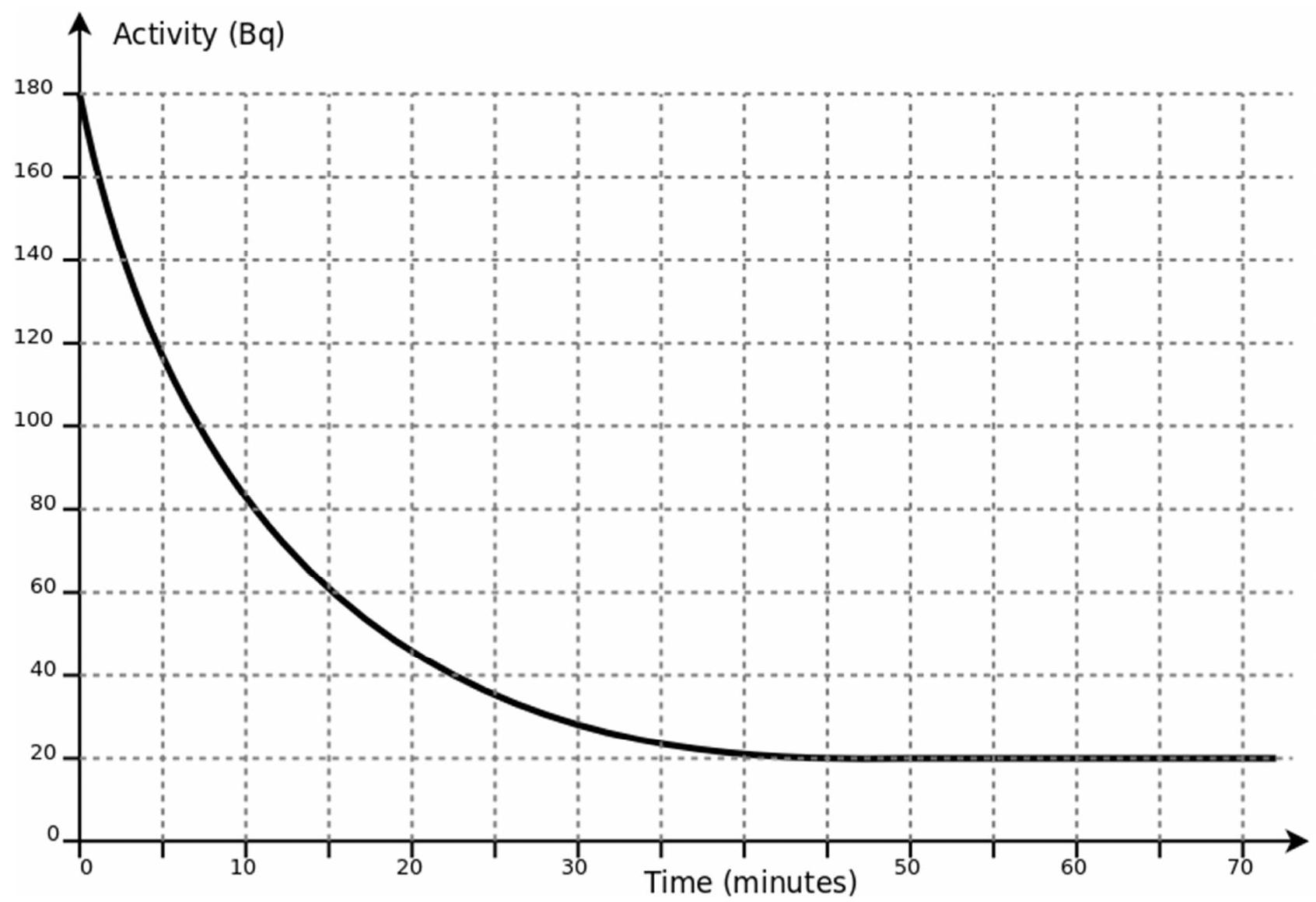
(2013-4) The graph shows how the activity of a radioactive sample changes over time.

figure

The half-life of the sample is approximately:
A. $\quad 5 \mathrm{~minutes}$
B. $\quad 7.5 \mathrm{~minutes}$
C. $\quad 9 \mathrm{~minutes}$
D. $\quad 15 \mathrm{~minutes}$
E. $\quad 40 \mathrm{~minutes}$

Reveal answer
AnswerB
Show worked solution

To find the half-life of a radioactive sample, we need to determine the time it takes for its activity to reduce to half of its initial value.

Given the graph of activity vs. time, identify the initial activity level, $A_0$, at $t = 0$. Let's assume this value is found at the uppermost point of the curve on the y-axis of the graph.

Next, determine the activity level $A_1 = \frac{1}{2} A_0$, which is half of the initial activity.

Locate the point on the time axis where the activity curve intersects with $A_1$. The corresponding time at this intersection is the half-life of the radioactive sample.

Upon examining the graph, it's observed that the time taken for the activity to decrease from $A_0$ to $\frac{1}{2} A_0$ approximates 7.5 minutes.

Hence, the half-life of the radioactive sample is approximately 7.5 minutes, which corresponds to option B.

2013-5A · MCQd2Atomic and Nuclear Physics · Atomic/nuclear model (Rutherford scattering)

(2013-5) In Rutherford's famous alpha particle scattering experiment, small positively charged subatomic particles called alpha particles were fired at a very thin sheet of gold foil. Most of the alpha particles passed straight through the gold foil as expected but, much to Rutherford's surprise, some of the alpha particles bounced off the gold foil at large angles. The results of this experiment suggest that:
A. Atoms have a small dense nucleus
B. Atoms contain charged particles
C. Atoms have orbiting electrons
D. Atoms are small hard spherical objects
E. Gold can be used to make effective mirrors

Reveal answer
AnswerA
Show worked solution

In Rutherford's alpha particle scattering experiment, the key observation was that while most alpha particles passed through the gold foil, a small fraction was deflected at large angles. This observation was crucial in understanding the structure of the atom.

The unexpected deflection of alpha particles suggested that there must be a concentrated region of positive charge within the atom, which repelled these positively charged alpha particles. This concentrated region could not be extended throughout the atom (as it would not have caused large angle deflections), nor could it be absent (as some particles were deflected).

The results indicate that:

$$ \mathrm{The atom consists of a small and dense positively charged region, known as the nucleus.} $$

This nucleus accounts for nearly all the mass of the atom. The fact that only a few particles were deflected implies the nucleus is very small compared to the rest of the atom, which is largely empty space, allowing most alpha particles to pass through unimpeded.

The remaining options do not align with the conclusions drawn from the experiment:

- Atoms contain charged particles, but this alone does not explain the large angle deflections. - The presence of orbiting electrons (option C) was not a direct conclusion from this experiment; rather, it was about the structure of the nucleus. - The model of atoms as small hard spherical objects (option D) is inconsistent with the observed deflections and the concept of a small nucleus. - Gold being used to make effective mirrors (option E) is unrelated to the scattering experiment.

Thus, the experimental results primarily suggest that atoms have a small dense nucleus. Hence, the correct answer is:

$$ \mathrm{A. Atoms have a small dense nucleus} $$

2014-7A · MCQd3Atomic and Nuclear Physics · Properties of half-life

(2014-7) The initial activity of a radioactive isotope is 120 Bq and the half-life is 20 minutes. For a sample of the same isotope with twice the mass, the values would be:

Initial Activity / $\mathrm{Bq}$Half Life / $\mathrm{minutes}$
A$120$$20$
B$240$$20$
C$60$$20$
D$120$$40$
E$120$$10$
Reveal answer
AnswerB
Show worked solution

To solve this problem, we must understand the relationship between the activity of a radioactive sample and its physical properties such as mass and half-life.

The activity $A$ of a radioactive isotope is directly proportional to the number of radioactive nuclei present, which in turn is proportional to the mass of the sample. This can be represented as follows:

$$ A \propto N $$

where $N$ is the number of radioactive nuclei.

For a given isotope, if the mass of the sample is doubled, the number of nuclei $N$ also doubles, because the number of atoms is proportional to the sample mass.

Thus, when the mass is doubled, the activity doubles:

$$ A_{ \mathrm{new} } = 2 \times A_{ \mathrm{initial} } $$

Given in the problem, the initial activity $A_{\text{initial}}$ is $120 \, \text{Bq}$. For a sample with twice the mass, the new activity is:

$$ A_{ \mathrm{new} } = 2 \times 120 \, \mathrm{Bq} = 240 \, \mathrm{Bq} $$

The half-life of a radioactive isotope is a fundamental property that does not change with the amount of the substance. Therefore, the half-life remains constant regardless of the sample size. In this case, the half-life remains:

$$ t_{\frac{1}{2}} = 20 \, \mathrm{minutes} $$

Combining these calculations, for a sample with twice the mass, the initial activity is $240 \, \text{Bq}$ and the half-life remains $20 \, \text{minutes}$.

Referring to the table given in the problem, this matches the values provided in choice B:

$$ \mathrm{Initial Activity: } 240 \, \mathrm{Bq} , \mathrm{Half-Life: } 20 \, \mathrm{minutes} $$

Thus, the correct answer is B.

2015-9A · MCQd4Atomic and Nuclear Physics · Half-life with background

(2015-9) A radiation detector is used to investigate the activity of a radioactive source. The detector will record the activity of the source and will also record any background radiation. In one particular experiment the activity was measured as 185 Bq. Two half-lives later the activity was measured as 50 Bq.

The background activity was:
A. $\quad 0 \mathrm{~Bq}$
B. $\quad 5 \mathrm{~Bq}$
C. $\quad 25 \mathrm{~Bq}$
D. $\quad 68 \mathrm{~Bq}$
E. $\quad 135 \mathrm{~Bq}$

Reveal answer
AnswerB
Show worked solution

Initially, let the total recorded activity consist of the source activity $A_s$ and the background activity $A_b$.

Given, the initial recorded activity is 185 Bq. Thus:

$$ A_s + A_b = 185 \, \mathrm{Bq} $$

After two half-lives, the activity due to the radioactive source is reduced to one-fourth of its original activity because with each half-life the radioactive substance halves.

Thus, after two half-lives:

$$ A_s' = \frac{A_s}{4} $$

At this time, the recorded activity becomes 50 Bq. Therefore:

$$ A_s' + A_b = 50 \, \mathrm{Bq} $$

Substituting $A_s'$ with $\frac{A_s}{4}$ in the equation:

$$ \frac{A_s}{4} + A_b = 50 $$

Now, we have two equations:

1. $A_s + A_b = 185$

2. $\frac{A_s}{4} + A_b = 50$

Subtract the second equation from the first to eliminate $A_b$:

$$ (A_s + A_b) - \left(\frac{A_s}{4} + A_b\right) = 185 - 50 $$

Simplifying gives:

$$ A_s - \frac{A_s}{4} = 135 $$

$$ \frac{3A_s}{4} = 135 $$

Solve for $A_s$:

$$ A_s = \frac{4}{3} \times 135 $$

$$ A_s = 180 \, \mathrm{Bq} $$

Substitute $A_s = 180$ Bq back into the first equation:

$$ 180 + A_b = 185 $$

Solving for $A_b$:

$$ A_b = 185 - 180 $$

$$ A_b = 5 \, \mathrm{Bq} $$

Thus, the background activity is 5 Bq. The answer is B.

2016-10A · MCQd4Atomic and Nuclear Physics · Radioisotope dating (carbon-14)

(2016-10) There are two isotopes of carbon. Carbon-14 is radioactive. Carbon-12 is stable. The half life of Carbon-14 is 5730 years. Carbon-14 is produced naturally in the atmosphere and absorbed by all living things. Therefore, in all living things, the ratio of Carbon-14 to Carbon-12 is the same and remains constant.

In a sample of dead organic material, the ratio of Carbon-14 to Carbon-12 is found to be $4 / 5$ of the expected value for living material.

The best estimate of the age of the dead organic material is:
A. 1150 years
B. 1840 years
C. 2870 years
D. 4580 years
E. 5730 years

Reveal answer
AnswerB
Show worked solution

The problem involves determining the age of a sample based on its Carbon-14 to Carbon-12 ratio, using the concept of radioactive decay. Carbon-14 decays over time, and the process is described by its half-life.

The half-life of Carbon-14 is given as 5730 years. This means that after 5730 years, half of the original Carbon-14 isotopes in a sample would have decayed.

To find the age of the sample, we need to use the formula for radioactive decay:

$$ N(t) = N_0 \left(\frac{1}{2}\right)^{\frac{t}{T_{1/2}}} $$

where $N(t)$ is the amount of Carbon-14 at time $t$, $N_0$ is the original amount of Carbon-14 when the organism was alive, $T_{1/2}$ is the half-life of Carbon-14, and $t$ is the time elapsed since the organism died.

Given in the problem, the ratio of Carbon-14 to Carbon-12 in the sample is $\frac{4}{5}$ of the ratio in living organisms. Therefore, we can state:

$$ \frac{N(t)}{N_0} = \frac{4}{5} $$

Substituting the decay formula in, we have:

$$ \left(\frac{1}{2}\right)^{\frac{t}{5730}} = \frac{4}{5} $$

To solve for $t$, take the logarithm of both sides:

$$ \log\left(\left(\frac{1}{2}\right)^{\frac{t}{5730}}\right) = \log\left(\frac{4}{5}\right) $$

Using the logarithm power rule:

$$ \frac{t}{5730} \log\left(\frac{1}{2}\right) = \log\left(\frac{4}{5}\right) $$

Solving for $t$, we rearrange the equation:

$$ t = 5730 \frac{\log\left(\frac{4}{5}\right)}{\log\left(\frac{1}{2}\right)} $$

Calculating the values:

$$ t = 5730 \times \frac{\log(0.8)}{\log(0.5)} $$

Using a calculator to find logarithm values:

$$ \log(0.8) \approx -0.0969100 $$ $$ \log(0.5) \approx -0.301030 $$

Substitute these values back into the equation:

$$ t \approx 5730 \times \frac{-0.0969100}{-0.301030} $$

$$ t \approx 5730 \times 0.322 $$

$$ t \approx 1843.86 $$

Rounding this to the closest option, the best estimate of the age of the dead organic material is approximately 1840 years.

Thus, the correct answer is B.

2017-9A · MCQd2Atomic and Nuclear Physics · Properties of half-life

(2017-9) Iodine has several radioactive isotopes. A sample of an iodine compound containing a radioactive isotope of iodine can be used as a tracer in medical physics. The half-life the Iodine isotope is affected by:
A. $\quad \text{The temperature of the sample}$
B. $\quad \text{The chemical composition of the Iodine compound}$
C. $\quad \text{The quantity of isotope present in the sample}$
D. $\quad \text{The time since the sample was prepared}$
E. $\quad \text{None of the above}$

Reveal answer
AnswerE
Show worked solution

The half-life of a radioactive isotope is a fundamental property of the isotope, and it refers to the time required for half of the radioactive nuclei in a given sample to decay. This property is inherent to the isotope itself and is independent of external conditions.

Let's examine each option to determine if any affects the half-life:

A. The temperature of the sample

Temperature primarily affects the motion of atoms and molecules in a material. However, nuclear decay processes, which determine the half-life, occur at the nuclear level and are generally unaffected by temperature changes. Therefore, the half-life remains constant irrespective of temperature variations.

B. The chemical composition of the Iodine compound

Chemical composition relates to the arrangement of atoms in a molecule and the bonds between them. While chemical reactions involve electron interactions, radioactive decay involves changes in the nucleus. Thus, the half-life of a radioactive isotope is not influenced by its chemical form or the compound in which it resides.

C. The quantity of isotope present in the sample

The half-life is a statistical measure of the decay process and does not depend on how much of the isotope is initially present. Whether the sample contains a few atoms or a large amount, the time taken for half of the radioactive nuclei to decay remains the same.

D. The time since the sample was prepared

The half-life is a constant value describing the rate of decay over time. It does not change based on the time elapsed since the preparation of the sample. The half-life is the same irrespective of when the measurement starts.

After examining each option, it is clear that none of these factors-temperature, chemical composition, quantity of the isotope, or time since preparation-affect the half-life of a radioactive isotope. Consequently, the correct answer is:

E. None of the above

The half-life is a fixed property of a radioactive isotope and is invariant to external conditions discussed in options A through D.

2023-9A · MCQd4Atomic and Nuclear Physics · Activity to power conversion

(2023-9) A radioisotope power source of the type used to provide electrical energy for space missions uses the radioactive isotope Plutonium-$238$ ($\mathrm{Pu}^{238}$). Plutonium-238 decays by alpha decay. The activity of 1 gram of Plutonium-238 is $6.3 \times 10^{11} \mathrm{~Bq}$. The energy released by each alpha decay is $9.0 \times 10^{-13} \mathrm{~J}$. The mass of Plutonium-238 needed to provide a power of 100 W is approximately:
A. $\quad 100 \mathrm{~g}$
B. $\quad 140 \mathrm{~g}$
C. $\quad 180 \mathrm{~g}$
D. $\quad 238 \mathrm{~g}$

Reveal answer
AnswerC
Show worked solution

To find the mass of Plutonium-238 needed to provide a power of 100 W, we first need to determine the relationship between activity, energy per decay, and power.

The activity $A$ of Plutonium-238 is given as $6.3 \times 10^{11} \, \mathrm{Bq/g}$. This means that 1 gram of Plutonium-238 undergoes $6.3 \times 10^{11}$ decays per second.

The energy released per alpha decay is $9.0 \times 10^{-13} \, \mathrm{J}$.

The power output $P$ is the energy released per unit time, given by the equation:

$$ P = \mathrm{Activity} \times \mathrm{Energy per decay} $$

For 1 gram of Plutonium-238:

$$ P_1 = (6.3 \times 10^{11} \, \mathrm{Bq}) \times (9.0 \times 10^{-13} \, \mathrm{J}) $$

Calculating the above:

$$ P_1 = 5.67 \times 10^{-1} \, \mathrm{W} $$

This is the power provided by 1 gram of Plutonium-238. To find the mass needed to provide 100 W, use the proportionality:

$$ m = \frac{P_{ \mathrm{desired} }}{P_1} $$

Substitute the values:

$$ m = \frac{100 \, \mathrm{W}}{5.67 \times 10^{-1} \, \mathrm{W/g}} $$

Calculating this gives:

$$ m \approx 176.3 \, \mathrm{g} $$

Rounding to the nearest practical value, the mass of Plutonium-238 needed is approximately

$$ \boxed{180 \, \mathrm{g}} $$

2024-7A · MCQd2Atomic and Nuclear Physics · Radioisotope dating (carbon-14)

(2024-7) Carbon-14 is a radioactive isotope with a half-life of approximately 5700 years. Carbon dating can be usefully used to date samples that are roughly:

A.$1000000$ years old
B.$10000$ years old
C.$100$ years old
D.$1$ year old
Reveal answer
AnswerB
Show worked solution

Carbon-14 dating works by measuring the amount of radioactive carbon-14 remaining in a sample of organic material. Living organisms continuously exchange carbon with their environment, maintaining a constant ratio of carbon-14 to stable carbon-12. When an organism dies, this exchange stops, and the carbon-14 begins to decay without being replenished.

The decay of radioactive isotopes follows the equation: $$ N = N_0 \left( \frac{1}{2} \right)^{t/t_{1/2}} $$ where $N$ is the remaining amount, $N_0$ is the initial amount, $t$ is the elapsed time, and $t_{1/2}$ is the half-life.

For carbon-14, the half-life is approximately $5700$ years. After $n$ half-lives, the fraction remaining is $(1/2)^n$. The practical limit for carbon dating occurs when too little carbon-14 remains to measure accurately. After about 10 half-lives: $$ \left( \frac{1}{2} \right)^{10} = \frac{1}{1024} \approx \frac{1}{1000} $$ only about $0.1\%$ of the original carbon-14 remains, which becomes difficult to measure accurately.

The maximum useful age is therefore approximately: $$ 10 \times 5700\ \mathrm{years} = 57000\ \mathrm{years} $$

Carbon dating is therefore most useful for samples ranging from a few hundred years to about $50000$--$60000$ years old. Among the given options:

  • $1000000$ years old -- far beyond the useful range (option A)
  • $10000$ years old -- well within the useful range (option B)
  • $100$ years old -- too recent, the decay is minimal (option C)
  • $1$ year old -- far too recent for useful dating (option D)

2025-10A · MCQd3Atomic and Nuclear Physics · Half-life from decay graph

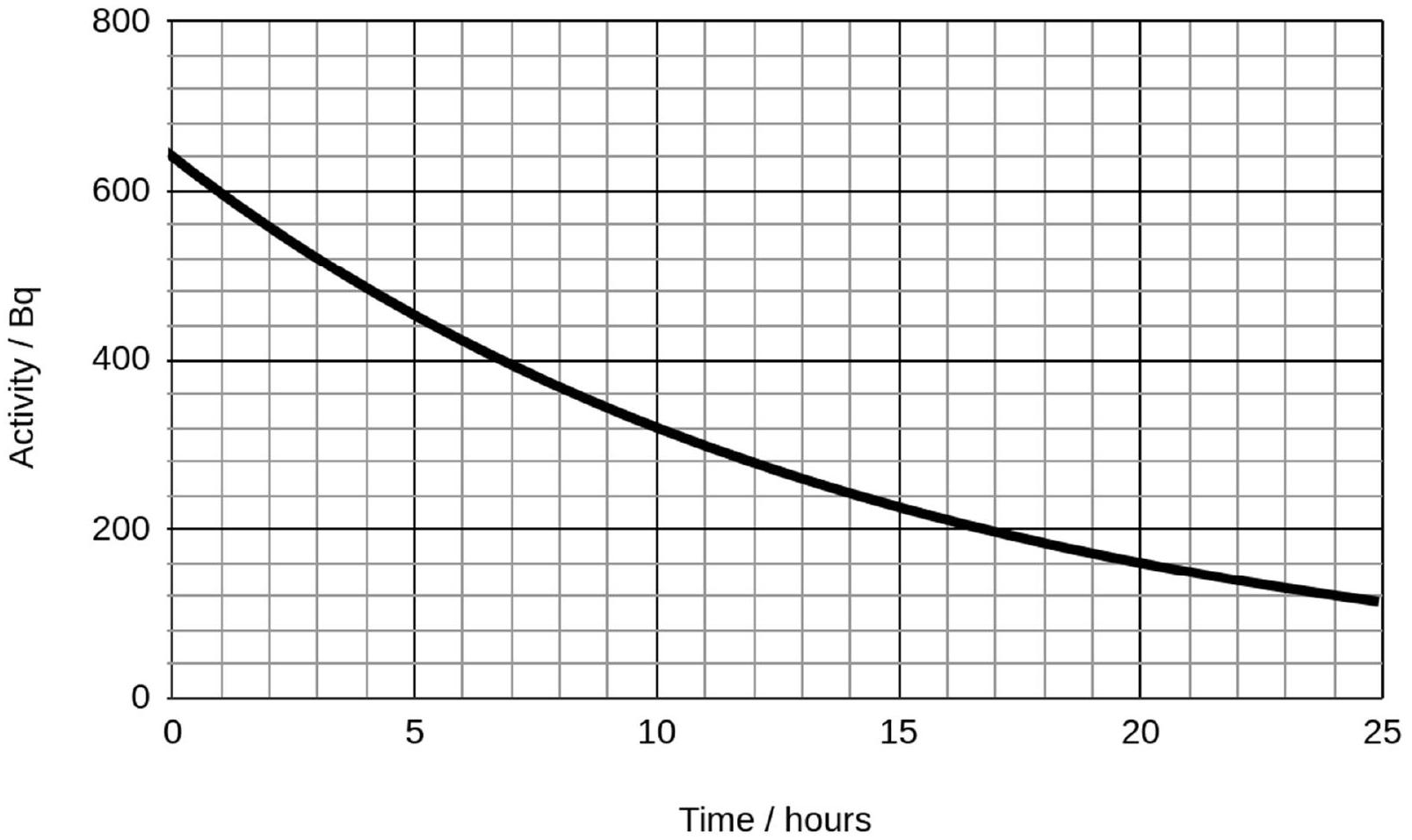
(2025-10) A sample of a radioactive isotope with an initial activity of 640 Bq and a half-life of several hours is prepared for use in a medical procedure.

figure

The time taken for the activity of the sample to reduce to 10 Bq is approximately:

A.40 hours
B.60 hours
C.80 hours
D.100 hours
Reveal answer
AnswerB
Show worked solution

To solve this problem, we need to use the radioactive decay law and read information from the graph to determine the half-life.

Radioactive decay follows the equation: $$ A = A_0 \left( \frac{1}{2} \right)^{t/t_{1/2}} $$ where $A$ is the activity at time $t$, $A_0$ is the initial activity, and $t_{1/2}$ is the half-life.

We need to find the time for the activity to decrease from $A_0 = 640\ \mathrm{Bq}$ to $A = 10\ \mathrm{Bq}$: $$ \frac{10}{640} = \left( \frac{1}{2} \right)^{t/t_{1/2}} \quad \Rightarrow \quad \frac{1}{64} = \left( \frac{1}{2} \right)^{t/t_{1/2}} $$

Since $64 = 2^{6}$, we have $(1/2)^{6} = (1/2)^{t/t_{1/2}}$, which means: $$ \frac{t}{t_{1/2}} = 6 \quad \Rightarrow \quad t = 6 t_{1/2} $$

So we need 6 half-lives for the activity to reach 10 Bq.

From the graph, we can estimate the half-life by observing how the activity changes over time. Looking at the graph:

  • At $t = 0$, $A = 640\ \mathrm{Bq}$
  • At $t \approx 10\ \mathrm{hours}$, the activity has dropped to about $320\ \mathrm{Bq}$ (one half-life)
  • At $t \approx 20\ \mathrm{hours}$, the activity has dropped to about $160\ \mathrm{Bq}$ (two half-lives)

This confirms that $t_{1/2} \approx 10\ \mathrm{hours}$.

The total time required is therefore: $$ t = 6 \times 10\ \mathrm{hours} = 60\ \mathrm{hours} $$